

TL;DR
The best AI tools for writing news articles excel at research, rapid drafting, and source verification. Leading options blend the research power of tools like Perplexity, which provides citations for fact-checking, with the versatile writing capabilities of Large Language Models (LLMs) such as ChatGPT and Claude. The key is to use AI as an assistant to augment journalistic skills, not replace them, always maintaining strict human oversight for accuracy and ethical integrity.
The Evolving Role of AI in Modern Journalism
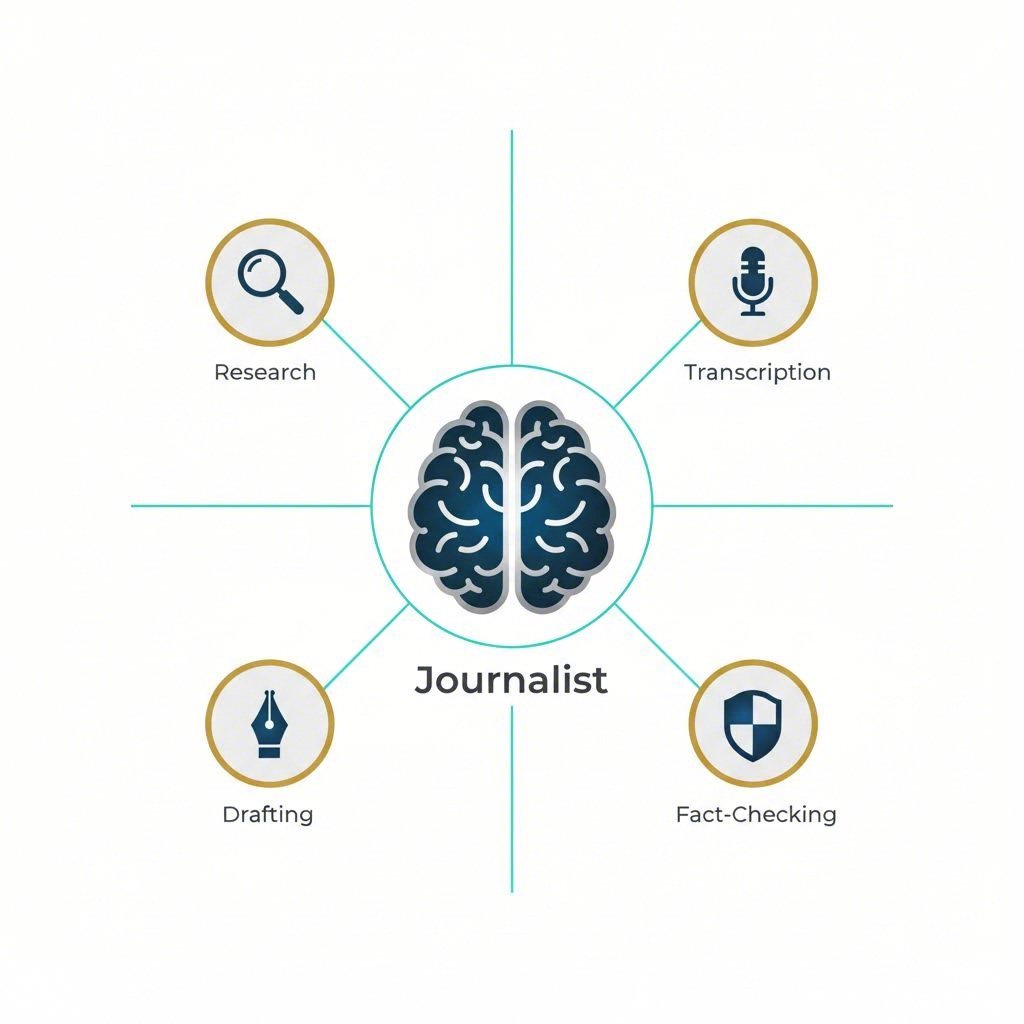
Artificial intelligence writing tools are no longer a novelty; they are becoming integral assistants in modern newsrooms. Far from being simple content spinners, these tools are sophisticated platforms that leverage Large Language Models (LLMs) and Natural Language Processing (NLP) to assist journalists with a range of tasks. Their primary role is to enhance efficiency, allowing reporters and editors to focus on high-value work like investigative journalism, source building, and nuanced storytelling. AI can generate summaries of press releases, transcribe lengthy interviews in minutes, and analyze large datasets to uncover trends that might otherwise go unnoticed.
While AI can indeed generate news articles, its current capabilities come with significant limitations. An AI can produce a clean, AP-style first draft based on a set of provided sources, but it cannot conduct original reporting, interview a source, or understand the subtle context of a sensitive issue. As Ashwin Balani of the NBCU News Group notes, AI works best as a time-saver for repetitive tasks, but it always requires a “human in the loop” to ensure accuracy and ethical judgment. The technology is a powerful assistant, not an autonomous reporter.
Integrating these tools effectively requires a clear understanding of their strengths and weaknesses. The primary benefits lie in speed and scale. A journalist can use an AI tool to generate multiple headline options, draft a quick brief on a developing story, or get a readable transcript from an audio file. However, the risks are equally significant and must be managed proactively.
- Pros of Using AI in News Writing:
- Speed and Efficiency: Drastically reduces time spent on tasks like transcription, summarizing documents, and writing initial drafts.
- Data Analysis: Capable of processing vast amounts of data to identify patterns, trends, and story ideas that a human might miss.
- Content Ideation: Helps overcome writer's block by generating outlines, headlines, and different angles for a story.
- Consistency: Can be trained to adhere to a specific style guide (like AP style), ensuring consistency across multiple articles.
- Cons of Using AI in News Writing:
- Factual Inaccuracies (Hallucinations): AI models can invent facts, statistics, or quotes that sound plausible but are entirely false.
- Lack of Nuance and Context: AI struggles to understand the subtleties of human emotion, cultural context, and ethical dilemmas crucial to responsible journalism.
- Potential for Bias: AI models are trained on existing data from the internet, which can contain and perpetuate societal biases.
- No Original Reporting: AI cannot replace the core journalistic function of gathering new information through interviews, observation, and investigation.
Ultimately, the ethical and effective use of AI in the newsroom hinges on treating it as a specialized tool within a human-led workflow. It can accelerate the research and drafting phases, but every piece of AI-assisted content must be rigorously fact-checked, edited, and approved by a human journalist before publication.
Key Criteria for Selecting AI Tools for News Writing
Choosing the right AI tool for a newsroom environment is more complex than picking a general-purpose writer. The demands of journalism—accuracy, timeliness, and credibility—require a specific set of features. When evaluating options, journalists and editors should prioritize functionalities that support the core tenets of their profession. A tool that excels at creative marketing copy may be entirely unsuitable for producing a factual news brief.
The most critical criterion is factual accuracy and source citation. A news article is only as good as its sources. An AI tool that generates text without providing clear, verifiable citations is a liability. Leading tools in this space, like Perplexity, are built around a source-first model, linking claims directly to the articles, press releases, or reports they came from. This allows journalists to quickly verify information and maintain a high standard of accuracy. Without this feature, a journalist would have to spend more time fact-checking the AI's output than it would have taken to write the article from scratch.
Another non-negotiable feature is access to real-time information. News is, by definition, current. An AI tool trained on a static dataset that ends months or years ago is useless for covering breaking events. Tools like ChatGPT (with browsing), Gemini, and Perplexity connect to the live internet, enabling them to pull information from the latest reports and developments. This ensures that the content generated is relevant and timely. Speed, efficiency, and control over tone are also vital. The tool should be able to produce clean, neutral copy in a standard format (like AP style) quickly, and it should allow the user to adjust the tone to be more analytical, explanatory, or straightforward as needed.
Feature Evaluation for Journalistic AI Tools
| Criterion | Good | Average | Poor |
|---|---|---|---|
| Factual Accuracy & Source Citation | Provides direct, clickable links to reputable sources for every major claim. | Mentions sources by name but does not provide direct links. | Generates information without any citations or sourcing. |
| Access to Real-Time Information | Connects to the live internet to pull the most current data and news. | Has a recent but not real-time knowledge cutoff date. | Relies on a static, outdated dataset. |
| Speed and Efficiency | Generates a well-structured first draft from a prompt in under a minute. | Takes several minutes or requires multiple complex steps to produce a draft. | Slow, buggy, or produces unusable output that requires a complete rewrite. |
| Neutrality and Tone Control | Easily adheres to prompts for neutral, AP-style tone and avoids marketing language. | Requires significant prompt engineering to achieve a neutral tone. | Defaults to an overly creative or promotional tone unsuitable for news. |
| Workflow Integration | Offers plugins or connectors for Google Docs, WordPress, or other CMS platforms. | Requires manual copy-pasting of all content between platforms. | Has a closed ecosystem that does not integrate with other tools. |
Checklist for Testing AI News Writing Tools
- Does the tool provide clear, verifiable sources for its claims?
- Can it access and process information from the last 24 hours?
- How quickly can it produce a usable 300-word brief from a press release?
- Can you easily instruct it to write in a neutral, journalistic tone?
- Does it offer features to streamline publishing, like WordPress or Google Docs integration?
- Is there a free tier or trial that allows for thorough testing of these core features?
The Best AI Tools for News: A Comparative Review
Navigating the landscape of AI writing tools requires a focus on specific journalistic tasks. No single tool does everything perfectly. Instead, the most effective approach is to build a small, disciplined stack that combines a primary writer for drafting, a research sidekick for verification, and an operational layer for consistency and publishing. The following tools are top contenders, each excelling in a particular part of the news-writing workflow.
For teams focused on scaling high-quality, SEO-driven content that can be adapted for news-style articles, a platform like BlogSpark's advanced AI blog writer is a powerful option. It excels at transforming ideas into engaging and original articles quickly, with features like intelligent outlining and customizable brand voice that ensure consistency. Its seamless integration with content management systems can significantly streamline the publishing process for digital news outlets and content marketers.
1. ChatGPT (Version 4o and higher)
- Best For: Fast, versatile first drafts and headline ideation.
- Key Features: With its browsing capability, ChatGPT can access real-time information to draft briefs on current events. It is highly adaptable to style prompts, making it easy to request AP-style paragraphs or a neutral tone. It's also excellent for brainstorming multiple headline options or summarizing complex documents.
- Pricing: Offers a robust free version; paid plans (Plus) provide access to the latest models and features.
- Pros: Extremely versatile, user-friendly interface, strong natural language understanding for complex prompts.
- Cons: Can confidently paraphrase without perfect accuracy; all facts, names, and dates must be human-verified.
2. Perplexity
- Best For: Research and fact-checking with built-in citations.
- Key Features: Perplexity's core strength is its source-first approach. It answers queries by synthesizing information from multiple online sources and provides direct, numbered links to them. This is invaluable for journalists who need to verify every claim quickly.
- Pricing: A free version is available; the Pro plan offers more advanced features and higher usage limits.
- Pros: Excellent for surfacing and linking to credible sources, reduces research time, minimizes the risk of hallucinations.
- Cons: Its prose is more functional than polished; it's best used as a research tool, not a final copywriter.
3. Claude
- Best For: Human-sounding prose and summarizing long documents.
- Key Features: Claude is known for producing text that sounds more natural and less robotic than some competitors. It has a large context window, meaning it can process and summarize very long documents (like reports or interview transcripts) with high accuracy. This makes it ideal for creating nuanced recaps.
- Pricing: Offers a free tier with daily limits; the Pro version provides significantly higher usage.
- Pros: Writes with clarity and a natural tone, excellent for handling large text inputs, good for sensitive topics where tone matters.
- Cons: Can sometimes have a gentler, less punchy style for headlines compared to ChatGPT.
4. Google's Gemini
- Best For: Outlining, creating glossaries, and integrating with Google Workspace.
- Key Features: Gemini is adept at structuring content. It can quickly generate clear outlines, define key terms for a glossary, and provide executive summaries. Its integration with Google Docs and other Workspace apps makes it a low-friction option for teams already in that ecosystem.
- Pricing: A free version is widely available; advanced features are part of paid Google One AI Premium plans.
- Pros: Strong at organizing information, excellent for generating alternative phrasings, and provides real-time web access.
- Cons: The writing tone can sometimes require calibration to sound completely neutral.
5. HyperWrite (AI Journalist)
- Best For: Automated article generation on specific topics.
- Key Features: Marketed as an "AI Journalist," this tool from HyperWrite is designed to generate news-style articles from simple prompts. It automates some of the drafting process, aiming to produce content that reads like a news report.
- Pricing: Operates on a freemium model with paid tiers for more extensive use.
- Pros: Specifically tailored for news article formats, can be a very fast way to get a first draft.
- Cons: Like all automated tools, it requires heavy editing and fact-checking to meet professional journalistic standards.
Ethical Guidelines and Best Practices for Using AI in Newsrooms
The integration of AI into journalism is not just a technological shift; it's an ethical one. The speed and scale offered by AI tools must be balanced with an unwavering commitment to the core principles of journalism: accuracy, fairness, and transparency. Without a strong ethical framework, newsrooms risk eroding the very trust they are built on. Establishing clear guidelines is essential before these tools are widely deployed.
The foremost ethical pillar is Accuracy. AI models are known to “hallucinate”—inventing facts, quotes, and sources with complete confidence. This makes human verification non-negotiable. A journalist must treat AI-generated text as an unverified tip, not a finished product. Every statistic, name, date, and claim must be checked against primary sources. As recommended by The Rank Masters, a simple rule is to link every claim to a credible source and, for sensitive topics, require two independent sources.
Transparency with the audience is another critical component. Readers have a right to know how the content they consume is created. Many news organizations are adopting policies that require a clear disclosure on articles that have been created with significant AI assistance. A simple line, such as “This article was drafted with AI assistance and was fact-checked and edited by a human journalist,” builds trust and sets clear expectations. Hiding the use of AI can lead to accusations of deception and damage a publication's credibility.
Finally, newsrooms must be accountable for all published content, regardless of how it was generated. This means taking responsibility for any errors, biases, or ethical lapses in AI-assisted articles. It also involves being vigilant about mitigating algorithmic bias. Since AI models learn from vast datasets of existing text, they can absorb and amplify societal biases present in that data. Editors and journalists must be trained to spot and correct biased language or framing that an AI might produce, ensuring that their reporting remains fair and equitable.
Actionable Best Practices Checklist
- Always Verify, Never Trust: Treat all AI-generated output as a starting point. A human must fact-check every detail against primary sources before publication.
- Establish a Clear Disclosure Policy: Create a consistent and transparent method for informing readers when AI has been used significantly in the creation of an article.
- Human in Command: Ensure that a human journalist or editor has the final say on all content. AI should assist, not decide.
- Train for Bias Detection: Educate journalists and editors on how to identify and correct algorithmic bias in AI-generated text.
- Protect Sensitive Information: Be cautious about inputting confidential source information or sensitive data into third-party AI platforms. Check the privacy policies of any tool, as noted by NBCU Academy.
- Use AI for Assistance, Not Reporting: Leverage AI for tasks like transcription, data analysis, and drafting, but reserve original reporting, interviewing, and critical analysis for human journalists.

Frequently Asked Questions
1. Can AI generate news articles?
Yes, AI can generate news articles. AI-powered tools can create professional, news-style articles based on user-provided topics, keywords, or source documents. However, these articles are essentially sophisticated summaries or reformulations of existing information. They lack original reporting, human insight, and the critical context that a professional journalist provides. Therefore, any AI-generated article requires thorough human fact-checking, editing, and review before it can be considered for publication.
2. Is ChatGPT the best AI writer?
ChatGPT is one of the most powerful and versatile AI writers available, making it a top choice for many tasks. Its strength lies in its ability to understand complex prompts, adapt to various writing styles, and generate coherent text for everything from emails to code. However, whether it's the "best" depends on the specific need. For journalistic research, a tool like Perplexity with its emphasis on citations might be better. For long-form, natural-sounding prose, some users prefer Claude. The best tool often depends on the specific stage of the writing workflow.
3. Which AI tool is best for writing reports?
For writing reports, the best AI tool often combines data analysis, summarization, and structured writing capabilities. Tools like Claude are excellent for this because they can process large documents or datasets and produce nuanced summaries. For reports that require up-to-the-minute information and clear sourcing, a combination of Perplexity for research and ChatGPT or Gemini for drafting the report structure and content is a highly effective workflow. The key is to choose a tool that can handle the specific data inputs and formatting requirements of the report.