

TL;DR
The term "Domain Rank" has two completely different meanings depending on the context. In biology, the Domain is the highest and most fundamental taxonomic rank used to classify all life, positioned above Kingdom. In the world of Search Engine Optimization (SEO), Domain Rank is a general term for metrics like Domain Rating (DR) or Domain Authority (DA), which evaluate a website's backlink strength and authority on a 0-100 scale.
Domain Rank in Biology: The Highest Level of Life's Classification
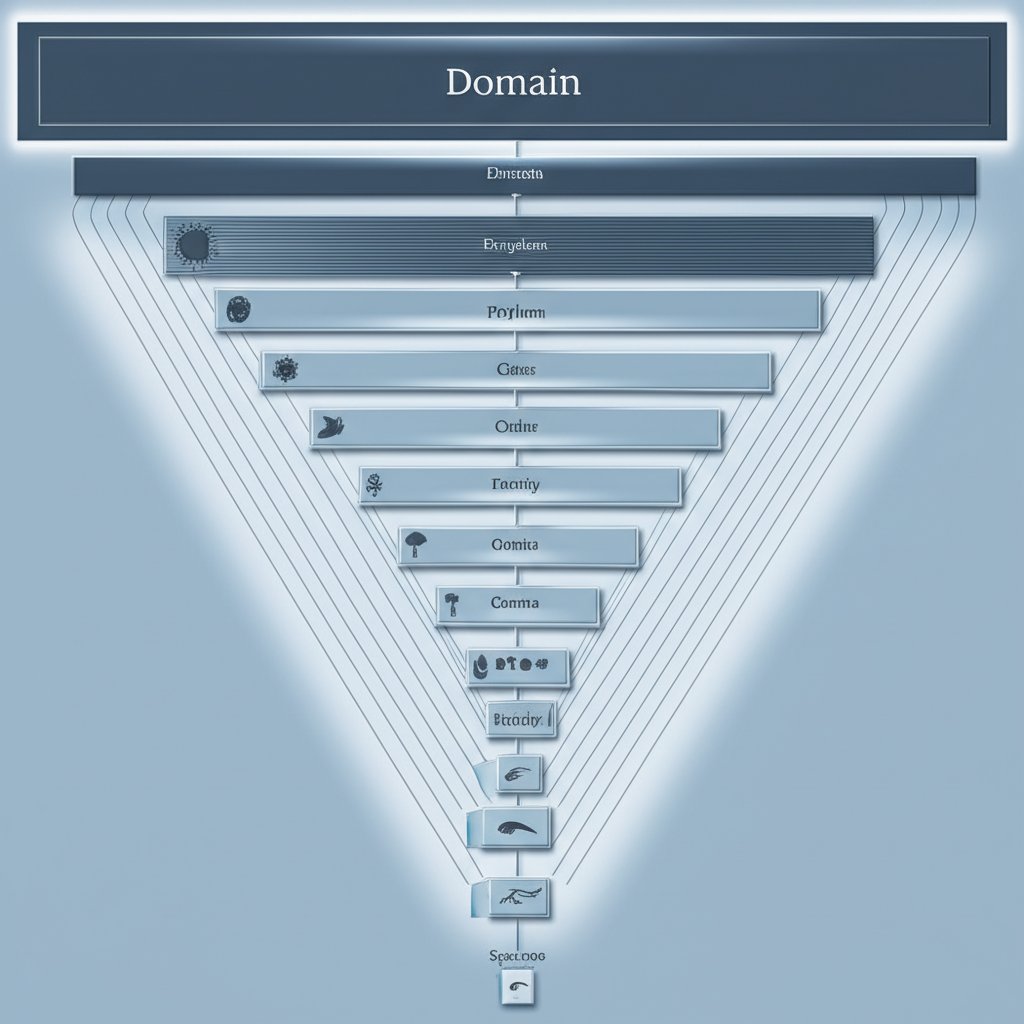
In the scientific field of taxonomy, the Domain is the broadest and most fundamental level of organism classification. It sits at the very top of the biological hierarchy, even above the well-known Kingdom rank. This classification level is a relatively recent addition to the system, introduced to account for profound evolutionary differences discovered in organisms at the cellular level. Understanding this rank is key to grasping the broadest branches of the tree of life.
The primary difference between the Domain rank and others like Kingdom, Phylum, or Class lies in its criteria. While lower ranks group organisms based on more specific shared characteristics—such as body structure, mode of nutrition, or reproductive methods—the Domain rank is based on fundamental differences in cellular chemistry and genetic makeup. This distinction led scientists to categorize all life into three distinct domains: Archaea, Bacteria, and Eukarya. Both Archaea and Bacteria consist of single-celled prokaryotic organisms, but they differ significantly in their genetics and cell wall composition. Eukarya, on the other hand, includes all organisms with a nucleus and other membrane-bound organelles, from single-celled protists to complex plants, fungi, and animals.
Because the Domain rank encompasses all known life, it naturally contains the largest number of organisms. Each subsequent rank becomes progressively more specific, containing fewer organisms that share more traits. This hierarchical structure allows scientists to organize and study the immense diversity of life in a logical and systematic way, from the most ancient and fundamental divisions to the most closely related species.
Comparing Taxonomic Ranks
To clarify its position, here is how the Domain rank compares to other major taxonomic levels:
| Rank | Basis for Classification | Example |
|---|---|---|
| Domain | Fundamental cellular structure and genetic differences (e.g., presence of a nucleus). | Eukarya |
| Kingdom | General body organization and nutritional modes. | Animalia (Animals) |
| Phylum | Basic body plan or organization. | Chordata (Vertebrates) |
| Class | More specific shared attributes. | Mammalia (Mammals) |
| Order | Groups of related families. | Primates |
Domain Rank in SEO: A Measure of Website Authority
In digital marketing and SEO, "Domain Rank" refers to a score that measures a website's authority and strength, primarily based on its backlink profile. It's important to clarify that this is not a metric used by Google to rank websites directly. Instead, it's a third-party metric developed by SEO software companies to provide a reliable proxy for a site's influence and potential to rank in search results. The two most prominent versions of this metric are Domain Rating (DR) by Ahrefs and Domain Authority (DA) by Moz.
These metrics operate on a logarithmic scale from 0 to 100, where higher scores indicate stronger authority. A website's score is calculated by analyzing the quantity and quality of other websites that link to it. A single backlink from a highly authoritative site like a major news outlet (with a high DR/DA) carries significantly more weight than hundreds of links from new or low-quality sites. This is because a link is seen as a vote of confidence; when a reputable site links to another, it signals trust and credibility. The logarithmic nature of the scale means it's much easier to grow a score from 20 to 30 than from 70 to 80, which requires earning links from the most authoritative domains on the web.
SEO professionals use these scores for several strategic purposes. The most common use is for competitive analysis, allowing marketers to benchmark their website's authority against competitors. It is also crucial for link-building campaigns. When seeking to acquire backlinks, marketers prioritize outreach to websites with high DR or DA scores to maximize the authority passed to their own site. A strong score often correlates with better search engine visibility and higher organic traffic. Marketers and creators looking to build authority often focus on producing high-quality content that naturally attracts links. For those aiming to scale their content creation, platforms like BlogSpark offer AI-powered tools to generate engaging, SEO-optimized articles, helping to streamline the workflow from keyword discovery to publication.
Domain Rating (DR) vs. Domain Authority (DA)
While often used interchangeably, DR and DA are calculated differently and serve slightly different purposes. Understanding their distinctions is crucial for a nuanced SEO strategy.
| Metric | Creator | Primary Focus | Key Factors |
|---|---|---|---|
| Domain Rating (DR) | Ahrefs | Strength of a website's backlink profile. | The quantity and quality (DR) of unique referring domains. It also considers how many other sites those referring domains link to. |
| Domain Authority (DA) | Moz | Predictive ability to rank in search results. | Uses over 40 factors, including linking root domains, total number of links, MozRank, MozTrust, and a machine-learning model trained against Google's SERPs. |
Key Differences Summarized: Biology vs. SEO
To avoid any confusion, it's essential to recognize that "Domain Rank" in biology and SEO are entirely unrelated concepts from different fields. One is a foundational principle of life sciences, while the other is a man-made metric for the digital world. Understanding the context is the only way to correctly interpret its meaning.
The following table provides a final, clear comparison of the two concepts, highlighting their distinct purposes, scales, and applications. This summary should resolve any lingering ambiguity and solidify your understanding of these two very different uses of the same term.
| Attribute | Domain Rank in Biology | Domain Rank in SEO |
|---|---|---|
| Field of Study | Taxonomy / Life Sciences | Digital Marketing / SEO |
| What it Measures | Fundamental evolutionary relationships of all life. | A website's authority based on its backlink profile. |
| Scale | Three distinct categories: Archaea, Bacteria, Eukarya. | A logarithmic score from 0 to 100. |
| Purpose | To classify all living organisms into the broadest possible groups. | To estimate a website's ranking potential and guide marketing strategy. |
Frequently Asked Questions
1. How is the domain rank different from other ranks in science?
In science, the Domain rank is different because it classifies organisms based on the most fundamental cellular and genetic characteristics, such as the presence or absence of a nucleus. This makes it the highest level of classification. Other ranks, like Kingdom, Phylum, and Class, group organisms based on more specific, shared physical traits and evolutionary history.
2. How is domain different from other ranks in SEO?
In SEO, metrics like Domain Rating (DR) and Domain Authority (DA) primarily evaluate a website's authority based on its backlink profile—the number and quality of sites linking to it. This differs from other SEO metrics like PageRank (a Google algorithm that assesses individual page importance) or keyword rankings, which measure performance for specific search queries.
3. Is domain the highest level of classification?
Yes, in the hierarchical system of biological classification, the Domain is the highest and most inclusive taxonomic rank. It sits above the Kingdom level and groups all life on Earth into three main categories: Archaea, Bacteria, and Eukarya.