

TL;DR
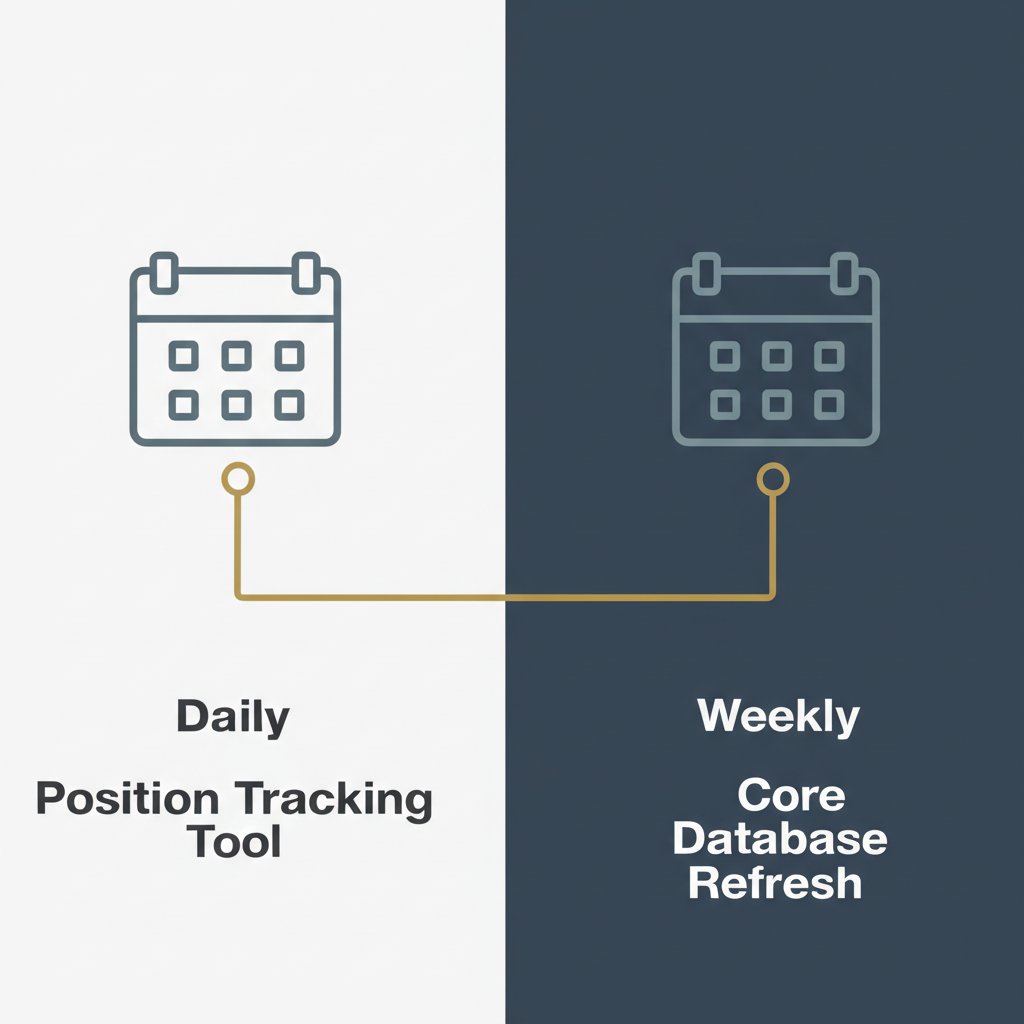
Semrush's update frequency is not a single, simple answer; it varies significantly across its different tools and databases. The Position Tracking tool, crucial for monitoring keyword rankings, updates its data daily. However, larger, core databases often receive major refreshes on a weekly basis. Furthermore, the freshness of data for any specific keyword is governed by the 'Live Update' algorithm, which prioritizes more popular search terms for daily updates while refreshing less common keywords weekly or even monthly.
Understanding Semrush's Core Database Update Schedule
One of the most common points of confusion regarding Semrush is the update frequency of its main databases, such as those for domain analytics and keyword research. You may find conflicting information online, with some sources claiming daily updates while others point to a specific weekly schedule. The reality is a hybrid of these processes. Semrush is constantly crawling the web and collecting new data, leading to daily refreshes in many metrics.
However, for the massive regional databases that power tools like Organic Research and Advertising Research, there is a more structured, large-scale update schedule. Several industry analyses point to a specific weekly refresh. For example, reports from both InvisiblePPC and Convex Interactive have noted that Semrush rolls out major database updates every Tuesday. This schedule allows for a comprehensive refresh of trillions of backlinks and billions of keywords, ensuring the data remains robust for strategic analysis.
This dual system explains why you might see minor fluctuations daily, but more significant shifts in competitor traffic estimates or keyword volumes after the main weekly update. Understanding this rhythm is key to interpreting the data correctly and not overreacting to small, daily changes. The key takeaway is that while data flows in continuously, the foundational datasets are consolidated and pushed on a predictable weekly cycle.
Daily Updates: The Position Tracking Tool
For digital marketers and SEO professionals who rely on timely rank tracking, the Semrush Position Tracking tool operates on a much faster schedule. According to Semrush's official knowledge base, this tool updates its keyword ranking data daily. These updates are automatic and cannot be manually scheduled, providing a consistent stream of information on your website's performance in the SERPs.
This daily frequency is critical for monitoring the impact of website changes, reacting to algorithm updates, and tracking the performance of targeted keywords. The data is not stored indefinitely at this granular level, however. Semrush tracks and displays daily ranking results for the most recent 60 days. After this period, the data is consolidated into weekly data points, which are stored for up to 140 weeks. This policy balances the need for immediate, high-frequency data with the practicalities of long-term data storage.
To leverage this daily data effectively, professionals should:
- Monitor Volatility: Keep a close eye on daily fluctuations to identify potential algorithm shifts or technical issues affecting your site's visibility.
- Track Campaign Impact: When you launch a new content campaign or make on-page SEO changes, the daily updates allow you to see the initial impact within 24-48 hours.
- Analyze Competitor Movements: Daily tracking helps you quickly identify when a competitor makes a significant move in the SERPs, allowing for a timely strategic response.
The 'Live Update' Algorithm: Not All Keywords Are Equal
Adding another layer of complexity to Semrush's update schedule is the 'Live Update' algorithm. This system, as detailed in Semrush's documentation, ensures that data for the most relevant and popular keywords is refreshed more frequently than data for obscure, long-tail queries. The core principle is that the update frequency of a keyword is directly tied to its search volume and popularity.
This tiered approach is a practical solution to managing a database of billions of keywords. It would be computationally prohibitive to update every single keyword every day. Instead, the Live Update algorithm prioritizes resources where they are most needed. High-volume, high-competition head terms might be checked daily, while medium-volume keywords are refreshed weekly, and very low-volume or niche keywords may only be updated monthly.
This explains why you might see ranking data for one of your main target keywords change every day, while a long-tail keyword's position appears static for weeks. It is not necessarily that the rank has not changed, but rather that Semrush has not re-crawled that specific SERP yet. Understanding this helps set realistic expectations for the freshness of data, especially when working in niche industries.
| Keyword Popularity | Typical Update Frequency | Example Keyword |
|---|---|---|
| High | Daily | 'best running shoes' |
| Medium | Weekly | 'how often semrush update' |
| Low | Monthly | 'seo for antique clock repair shops' |
Data Accuracy: Managing Expectations and Best Practices
Discussions about Semrush's update frequency often lead to questions about its data accuracy. It is not uncommon to find forum threads or blog posts where users report discrepancies between Semrush's metrics and the data in their first-party tools like Google Analytics or Google Search Console. This is an important and valid consideration. It's crucial to understand that tools like Semrush are third-party platforms that provide estimations based on vast datasets and proprietary algorithms. They are not direct sources of truth.
The primary purpose of Semrush is not to provide a 100% accurate, real-time reflection of your own website's traffic, but rather to offer powerful competitive intelligence and trend analysis. Discrepancies can arise because Semrush estimates traffic based on keyword positions and click-through-rate models, which can never be as precise as the actual data logged by your server. The perception that data hasn't updated for months, as sometimes noted by users, can often be attributed to tracking low-popularity keywords that are on a monthly refresh cycle via the Live Update algorithm.
To use Semrush effectively, it is essential to adopt the right mindset and follow best practices:
- Use it for Directional Analysis: Focus on trends, market share, and competitive landscapes rather than absolute traffic numbers. Is a competitor's visibility growing or shrinking over time? That is the key insight.
- Corroborate with First-Party Data: Always use Google Analytics and Search Console as your source of truth for your own site's performance. Use Semrush to understand the ecosystem *around* your site.
- Understand its Limitations: Acknowledge that all third-party SEO tools provide estimates. Use them to inform strategy, not to report exact figures as gospel.
- Integrate with a Full Workflow: Pair Semrush's analytical power with specialized creation tools. For instance, after identifying keyword opportunities in Semrush, you can streamline your content production. Marketers and creators can revolutionize their workflow with BlogSpark, an AI blog post generator that transforms ideas into engaging, SEO-optimized articles. By visiting https://blogspark.ai/, you can scale your output and act on the insights you've gathered.

Frequently Asked Questions
1. How often should a website be updated?
The ideal frequency for updating a website depends on its purpose. For content-driven sites like blogs, refreshing key articles with new information every three to six months is a good practice to maintain relevance and accuracy. Core website pages, like the homepage or service pages, should be reviewed at least annually. From a technical standpoint, software, themes, and plugins should be updated as soon as new versions are released to ensure security and functionality.
2. How often does Google refresh its search results?
Google's systems are in a state of constant flux, with thousands of changes made to its search algorithms each year. While major, announced core updates happen a few times per year, the search results themselves are refreshed continuously. The Googlebot is always crawling the web, and new pages can be indexed within hours or days. Therefore, there isn't a single 'refresh' time; the SERPs are dynamic and can change from minute to minute based on a multitude of factors.