

TL;DR
To effectively build backlinks in 2025, you must shift from chasing quantity to earning quality. This involves creating valuable, 'link-worthy' content—such as original research or free tools—that naturally attracts links. Combine this with strategic, value-driven outreach like guest posting on relevant sites, reclaiming unlinked brand mentions, and fixing broken links for other webmasters. The goal is to build authority and relevance, not just a high link count.
Understanding High-Quality Backlinks: Beyond the Metrics
In the evolving landscape of SEO, the definition of a high-quality backlink has matured significantly. It's no longer a simple numbers game focused on Domain Authority (DA) or Authority Score (AS). Today, search engines like Google prioritize links that signal genuine trust, relevance, and authority within a specific context. A truly valuable backlink in 2025 is one that comes from a reputable, topically aligned website and is placed naturally within helpful content.
According to insights from Semrush, relevance is a critical factor; a link from a niche sports blog to a page selling basketball shoes is far more valuable than a high-authority link from an unrelated site, such as a gardening blog. This is because search engine AI has become adept at understanding contextual relationships. It's not just about who links to you, but why. A link from a trusted source in your industry acts as an expert endorsement, telling search engines that your content is credible and useful to a relevant audience.
Furthermore, it's essential to understand the technical nuances of links, specifically the difference between "dofollow" and "nofollow" attributes. A standard link is inherently "dofollow," meaning it passes authority (or "link juice") and acts as a vote of confidence. A "nofollow" link, however, contains a `rel="nofollow"` tag that instructs search engines not to pass authority. While "dofollow" links are the primary goal for SEO, Rank Math notes that a natural backlink profile contains a healthy mix of both. Nofollow links from high-traffic sites can still drive valuable referral traffic and build brand awareness.
To ensure you're pursuing the right opportunities, use this checklist to evaluate potential backlinks:
- Relevance: Is the linking website and page content directly related to your niche and the content you want the link to point to?
- Authority: Does the website have a strong reputation and a clean backlink profile of its own?
- Contextual Placement: Is the link placed naturally within the main body of the content where it adds value to the reader?
- Traffic: Does the linking website receive real, organic traffic from your target audience?
- Editorial Standards: Is the site well-regarded, or does it appear to be a low-quality site designed only for link schemes?
Content-Led Link Building: Creating Your 'Linkable Asset'
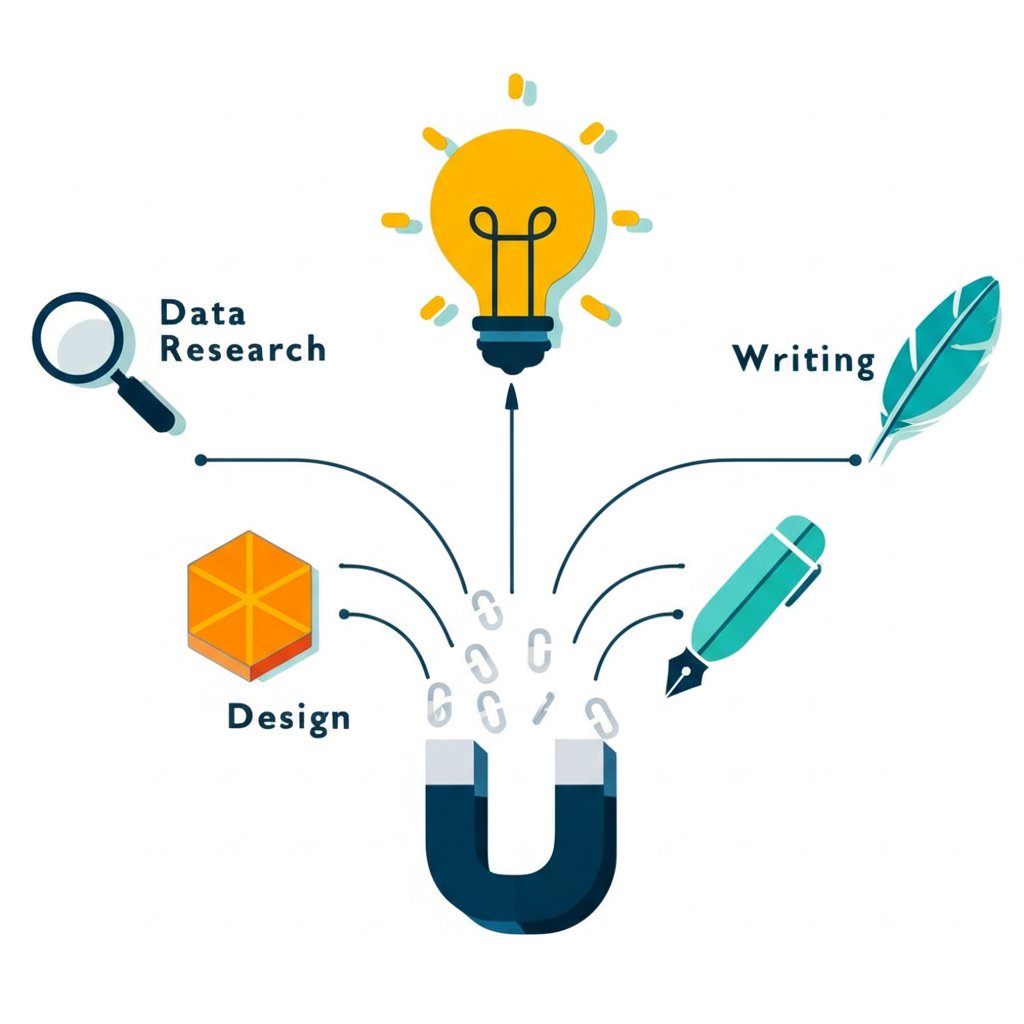
The most sustainable and powerful way to build backlinks is to create something worth linking to. This is the core principle behind creating a "linkable asset"—a high-value piece of content that naturally earns links because it serves as an exceptional resource for others in your industry. Instead of constantly asking for links, you create a magnet that pulls them in organically over time. This approach aligns perfectly with Google's emphasis on helpful, user-centric content.
Linkable assets come in various forms, each designed to provide immense value. As detailed by experts at Backlinko, some of the most effective types include original research and data studies, free online tools and calculators, comprehensive guides, and visually compelling assets like infographics. For example, a proprietary data study with fresh statistics becomes a go-to source for journalists and bloggers, while a free, useful calculator can be referenced repeatedly in tutorials and resource pages.
The process of scaling this content creation can be a significant hurdle for many teams. To streamline the workflow from ideation to publication, many marketers are turning to advanced tools. For instance, AI blog post generators like BlogSpark can help teams generate SEO-optimized drafts and outlines for in-depth guides, freeing up strategists to focus on the unique data and insights that make an asset truly link-worthy. This combination of AI efficiency and human expertise can dramatically increase your capacity to produce high-quality linkable content.
To help you decide which type of asset to create, consider the following comparison:
| Asset Type | Pros | Cons |
|---|---|---|
| Data Study/Original Research | Extremely high link potential; positions you as an authority; attracts media attention. | Time-consuming and can be expensive to produce; data can become outdated. |
| Free Tool/Calculator | Generates links over the long term; highly practical for users; can capture leads. | Requires development resources and budget; needs ongoing maintenance. |
| In-Depth Guide | Establishes topical authority; ranks for long-tail keywords; evergreen value. | Highly competitive; requires significant research and writing effort to stand out. |
| Visual Asset (e.g., Infographic) | Highly shareable; easily embeddable on other sites; simplifies complex information. | Requires design skills; can have lower perceived value than data or tools. |
Creating your first linkable asset involves a strategic process:
- Identify a Content Gap: Use competitor analysis to find topics that are popular but underserved. Look for outdated studies or guides that you can significantly improve upon.
- Create Something 10x Better: This is the heart of the "Skyscraper Technique," a concept popularized in the SEO community. Your content must be more comprehensive, better designed, more up-to-date, or more thorough than anything else available.
- Promote Your Asset: Once published, your work isn't done. Reach out to websites that link to similar, older resources and show them your superior alternative. Promote it to your audience and relevant online communities to build initial momentum.
Strategic Outreach and Relationship Building
While creating great content is foundational, strategic outreach is the engine that accelerates your link building efforts. Effective outreach in 2025 is about building genuine relationships and providing value, not just sending mass emails asking for links. It’s a human-centric approach that frames your request as a mutually beneficial partnership, where adding your link improves the quality and usefulness of the other person's content.
One of the most proven outreach tactics is guest posting. However, the modern approach, as highlighted by Siege Media, focuses on contributing genuinely valuable content to authoritative, niche-relevant websites. The goal is not just to secure a backlink but to share your expertise with a new audience and establish your brand's authority. This means pitching well-researched article ideas that perfectly fit the host blog's audience and editorial style, rather than sending generic, low-quality posts.
Another powerful method is becoming a source for reporters and bloggers. Platforms like Help a Reporter Out (HARO) and Connectively connect experts with journalists who need quotes and insights for their stories. By providing a timely and insightful response, you can earn high-authority backlinks from news outlets and established publications. This tactic positions you as an expert in your field and builds credibility that both search engines and users trust.
The key to successful outreach is personalization and value. A generic, templated email is easily ignored. A thoughtful, personalized pitch that shows you've done your research and understand the recipient's content will always have a higher success rate. For example, when pitching a guest post, your email should be concise, demonstrate your expertise, and clearly outline the value your proposed article offers their readers.
Here is a simple template for a guest post pitch:
Subject: Guest Post Idea: [Your Compelling Article Title]
Hi [Name],
I'm a huge fan of [Their Website Name] and especially loved your recent article on [Specific Article]. Your insights on [Specific Point] were spot on.
I'm reaching out because I've been working in [Your Industry] for [Number] years and had an article idea that I think your audience would find incredibly valuable: [Your Article Idea].
I could write a comprehensive, data-backed piece of around [Word Count] words, covering [Point 1], [Point 2], and [Point 3]. I've written for sites like [Example Site 1] and [Example Site 2] before.
Would this be something you're interested in?
Best,
[Your Name]
Technical and Opportunistic Link Building Tactics
Beyond content creation and direct outreach, there are several clever, technical tactics that leverage existing opportunities across the web. These methods are efficient, highly effective, and often feel like quick wins. Two of the most powerful opportunistic strategies are Broken Link Building (BLB) and link reclamation, both of which involve helping webmasters improve their websites while earning a link in return.
Broken Link Building is the process of finding links on other websites that point to dead or non-existent pages (a 404 error). Once you identify a broken link, you reach out to the site owner, inform them of the issue, and suggest your own relevant content as a replacement. This tactic is a win-win: you help the webmaster fix an error that hurts their user experience and SEO, and you get a quality, contextual backlink. The key is to have a high-quality replacement resource ready to go.
Link reclamation, on the other hand, involves finding mentions of your brand, products, or content online that don't include a link back to your site. These are often called "unlinked brand mentions." You can use tools like Google Alerts or brand monitoring software to find these mentions. Once you find one, you simply reach out to the author or webmaster with a polite email, thank them for the mention, and ask if they would be willing to add a link to it. The success rate for link reclamation is typically very high because the person has already shown an affinity for your brand.
Both of these strategies are endorsed by search engines because they focus on improving the overall quality of the web. They are not manipulative schemes but rather helpful actions that result in a more connected and user-friendly internet. Executing a successful campaign requires a methodical approach, especially for broken link building.
Here is a step-by-step guide to a Broken Link Building campaign:
- Identify Target Pages: Find authoritative pages in your niche that are likely to link out to other resources, such as resource pages, long-form guides, or listicles.
- Find Broken Links: Use a browser extension or an SEO tool to scan the target page for broken outbound links. Make a note of the dead link and what it originally pointed to.
- Find or Create a Replacement: Identify a piece of content on your own site that would be a perfect replacement for the dead resource. If you don't have one, this is a great opportunity to create a new, targeted asset.
- Conduct Helpful Outreach: Send a concise and friendly email to the site owner. Start by pointing out the broken link you found, and then suggest your resource as a potential replacement. Frame it as helping them, not just asking for a favor.

Frequently Asked Questions
1. How much does link building cost in 2025?
The cost of link building can vary dramatically based on the tactics used and the quality of the links sought. While some strategies like reclaiming unlinked mentions are virtually free, others involving extensive content creation or agency services can be a significant investment. Data suggests the average price for a single high-quality backlink can be over $500, and competitive niches may require monthly budgets in the thousands of dollars to see meaningful results.
2. How to raise domain authority in 2025?
Raising your website's domain authority (or Authority Score) in 2025 is a result of a holistic SEO strategy. The most crucial factor is consistently earning high-quality backlinks from relevant and trustworthy websites. This is best achieved by creating exceptional, link-worthy content that others want to cite. Additionally, strengthening your technical SEO, establishing deep topical authority by covering a subject comprehensively, and demonstrating high levels of Experience, Expertise, Authoritativeness, and Trustworthiness (E-E-A-T) all contribute to building your site's overall authority.