

TL;DR
Increasing your Ahrefs Domain Rating (DR) is achieved by systematically acquiring high-quality “dofollow” backlinks from unique and authoritative domains. This metric reflects the strength of your site's backlink profile, making quality over quantity the central strategy for improvement. Focus on creating link-worthy content and conducting strategic outreach to earn links from websites with strong DR scores themselves.
Understanding Ahrefs Domain Rating (DR)
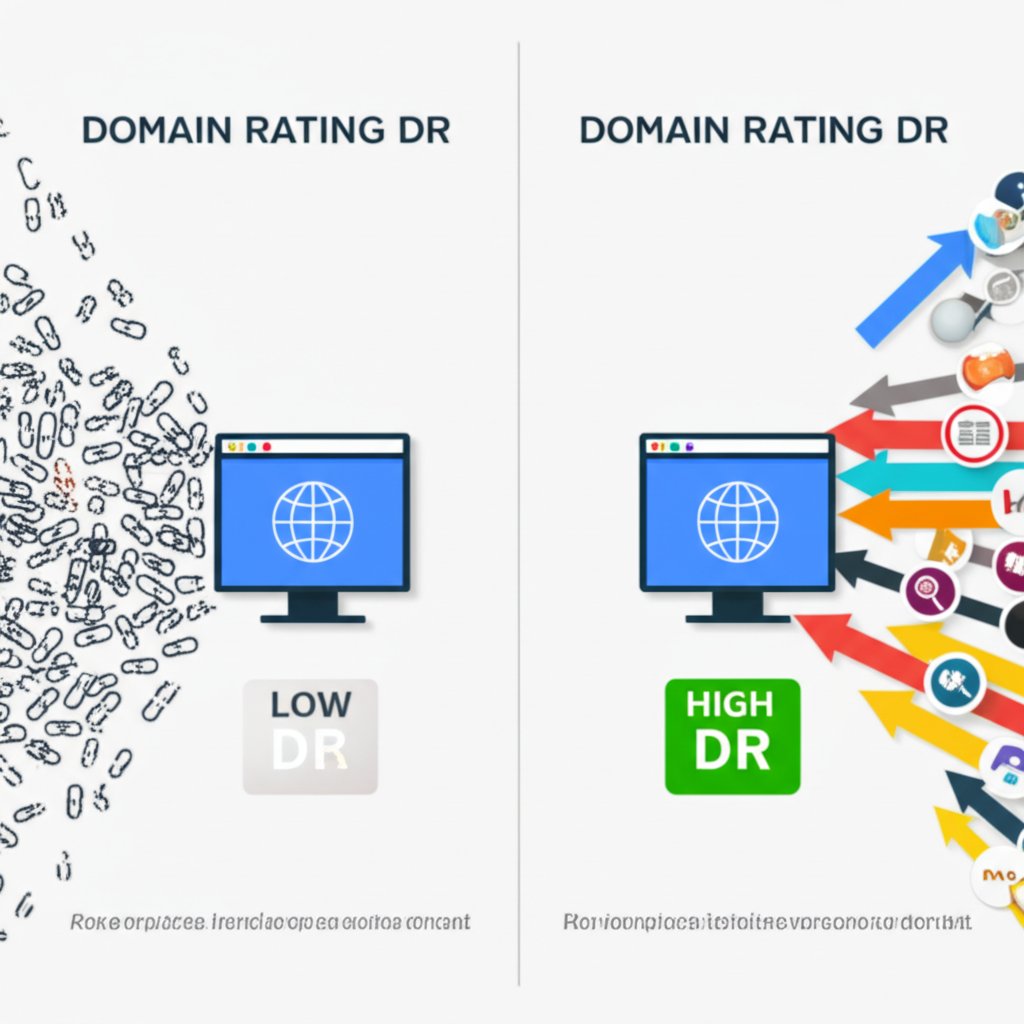
Before you can effectively increase your Domain Rating, it's crucial to understand what it represents. Ahrefs' Domain Rating is a proprietary metric that measures the relative strength of a website's backlink profile on a logarithmic scale from 0 to 100. A higher score indicates a stronger and more authoritative backlink profile. It is a comparative metric, meaning its primary value is in relation to your direct competitors.
The calculation of DR is based on several key factors. The most significant are the number of unique websites with at least one “dofollow” link pointing to your site and the DR score of those linking domains. A single link from a high-DR website can be more impactful than numerous links from low-DR sites. Furthermore, as explained in an Ahrefs article on website authority, the metric also considers how many other websites a linking domain links to; a site that links out sparingly passes more “DR equity” with each link.
A common question is, “What is a good Domain Rating?” Because DR is a relative metric, there is no universal “good” score. A DR of 40 might be excellent in a niche with smaller competitors, while a DR of 70 could be average in a highly competitive industry. A practical rule of thumb is that a good DR is one that is comparable to or higher than the sites you are directly competing with in search results. You can easily find your score using a free website authority checker tool.
Domain Rating (DR) vs. Domain Authority (DA)
It's easy to confuse Ahrefs' Domain Rating with Moz's Domain Authority (DA), but they are distinct metrics from different SEO tools. While both aim to measure a website's authority based on its backlink profile, their calculation methods differ. Understanding both can provide a more holistic view of your site's perceived strength.
| Metric | Provider | Primary Focus |
|---|---|---|
| Domain Rating (DR) | Ahrefs | Quantity and quality (DR) of unique referring domains with 'dofollow' links. |
| Domain Authority (DA) | Moz | Number of unique linking domains and the total number of backlinks. |
Core Strategies for Increasing Your Domain Rating
Improving your Domain Rating boils down to one central activity: building a strong profile of high-quality backlinks. This isn't about accumulating as many links as possible, but rather earning editorially placed “dofollow” links from relevant and authoritative websites. These links act as votes of confidence, signaling to search engines—and by extension, to Ahrefs' algorithm—that your site is a credible source of information.
The most effective and sustainable way to earn these valuable links is through a combination of creating exceptional content and strategic outreach. Your goal is to produce assets that other websites will want to reference and share with their audiences. Here are some of the most proven tactics:
- Create Link-Worthy Content: This is the foundation of any successful link-building campaign. Linkable assets are typically non-commercial pieces of content that provide immense value. This can include original research, comprehensive guides, free tools, or data-driven studies. For instance, a detailed report on industry benchmarks, like the one Ruler Analytics created using their own app data, can become a go-to source for journalists and bloggers, naturally attracting hundreds of backlinks.
- Strategic Outreach & Guest Posting: Once you have a valuable asset, you need to let the right people know it exists. This involves identifying websites in your niche that might be interested in your content and reaching out with a personalized pitch. Guest posting on reputable blogs is another effective method, allowing you to share your expertise with a new audience while securing a relevant backlink.
- Digital PR: This strategy involves creating newsworthy stories, studies, or data and promoting them to journalists and publications. When your work gets cited in the media, it often results in powerful backlinks from high-authority news sites, providing a significant boost to your DR.
For those looking to scale their content creation efforts to produce more linkable assets, tools are available to streamline the process. For example, marketers and creators can revolutionize their workflow with platforms like BlogSpark, an AI blog post generator designed to transform ideas into SEO-optimized articles quickly. By leveraging AI for keyword discovery and outlining, you can increase your content output, freeing up your team to focus on strategic planning and outreach. You can learn more by visiting https://blogspark.ai/ today.
Actionable First Steps for Beginners:
- Analyze Competitors: Use a tool like Ahrefs to analyze the backlink profiles of your top competitors. Identify the types of content that earn them the most links and look for opportunities you can replicate and improve upon.
- Identify a Linkable Asset Idea: Brainstorm a piece of content that would be highly valuable to your industry. Could you survey your audience to create a unique statistics page? Or build a simple calculator that solves a common problem?
- Build Your Target List: Create a list of 50-100 relevant blogs, publications, or resource pages in your niche that you would like to get a link from.
- Craft Your Pitch: Write a concise, personalized email explaining why your content would be a valuable addition to their site. Focus on the benefit to their audience, not just your own goals.
Advanced Tactics and Long-Term DR Maintenance
As your site grows, simply acquiring new links isn't enough. Maintaining and improving a high Domain Rating requires a more sophisticated approach that includes managing your existing backlink profile and setting realistic expectations. Many people search for ways to increase their domain authority quickly, but true, sustainable growth is a marathon, not a sprint. Services that promise rapid DR increases often use risky, black-hat techniques that provide no real SEO value and can even harm your site in the long run.
A crucial aspect of long-term maintenance is conducting periodic backlink audits. This process involves analyzing your backlink profile to identify and address potentially harmful or low-quality links. While Ahrefs doesn't explicitly state that toxic links negatively impact your DR, maintaining a clean profile is a widely accepted SEO best practice. Toxic links can come from spammy directories, private blog networks (PBNs), or irrelevant foreign websites. A healthy profile is one dominated by editorially given links from reputable, relevant sites.
Here is a high-level guide to performing a basic backlink audit:
- Export Your Backlinks: Use Ahrefs' Site Explorer to export a complete list of your referring domains.
- Identify Low-Quality Links: Systematically review the list, looking for red flags such as very low DR scores (e.g., 0-10), irrelevant topics, spammy anchor text, or sites in foreign languages unrelated to your business.
- Attempt Manual Removal: If you find a clearly harmful link, the first step should be to contact the site owner and request its removal. This is not always possible, but it's the preferred method.
- Use the Disavow Tool: For toxic links that you cannot get removed manually, Google's Disavow Tool should be used as a last resort. This tells Google to ignore these specific links when assessing your site, which can help mitigate any potential negative impact.
Finally, remember that DR is a relative and dynamic metric. As detailed in a Ahrefs help document, your score can drop even if you don't lose any links. This can happen if competitors are building links at a faster rate or if the DR of the sites linking to you decreases. Consistent, high-quality link building is the only way to ensure long-term, stable growth.
Key Takeaways for Sustainable DR Growth
Increasing your Ahrefs Domain Rating is a long-term investment in your website's authority and visibility. Rather than chasing a specific number, focus on the underlying strategies that lead to a strong and healthy backlink profile. The core principle is simple: earn high-quality, “dofollow” links from relevant and authoritative websites. This is best achieved by creating truly valuable, link-worthy content and actively promoting it to the right audiences.
Remember that DR is a relative metric, and its growth becomes more challenging as you climb the scale. A patient, consistent approach will always outperform risky shortcuts. Prioritize quality over quantity, regularly audit your backlink profile to keep it clean, and focus on building relationships within your industry. By making these principles the foundation of your SEO strategy, your Domain Rating will increase as a natural and deserved byproduct of your efforts.

Frequently Asked Questions About Ahrefs DR
1. What is a good domain rating in Ahrefs?
There is no absolute “good” Domain Rating. The metric is relative, meaning its value depends on the industry and your direct competitors. A strong DR is one that is comparable to or higher than the other websites ranking for your target keywords. The best approach is to benchmark your DR against your competitors' to set a realistic goal.
2. How can I increase my DR rating?
The primary way to increase your DR is to acquire more “dofollow” backlinks from unique websites with high DR scores. The most effective strategies to achieve this include creating link-worthy content like original research or free tools, conducting strategic outreach to relevant websites, and engaging in digital PR to earn media mentions.
3. How does Ahrefs calculate domain rating?
Ahrefs calculates Domain Rating based on the strength of a website's backlink profile. The key factors are the number of unique referring domains that have at least one “dofollow” link to your site and the DR score of those linking domains. The scale is logarithmic, meaning it's much harder to grow from DR 70 to 80 than from DR 10 to 20. The calculation also considers how many other sites a linking domain links to, as explained by SEO experts at Backlinko.