

TL;DR
Google Hummingbird was a comprehensive rewrite of Google's core search algorithm that launched in 2013. Its primary purpose was to shift from matching individual keywords to understanding the full context and intent behind natural, conversational search queries. Named for being 'precise and fast,' this update enabled Google to provide more relevant answers to complex, long-tail questions, paving the way for modern voice search and AI-driven results.
What Was the Google Hummingbird Update?
In September 2013, Google announced a significant overhaul of its core search algorithm, codenamed Hummingbird. Unlike previous updates like Panda or Penguin, which were add-ons designed to penalize specific low-quality tactics, Hummingbird was a complete replacement of the engine that processes search queries. As described in an FAQ from Search Engine Land published at the time, this was the most dramatic rewrite of the algorithm since 2001. Though announced on Google's 15th anniversary, the update had already been quietly running for about a month, affecting an estimated 90% of searches to a small degree.
The name 'Hummingbird' was chosen to reflect the algorithm's goal: to be both 'precise and fast.' The central innovation was its ability to parse the meaning of an entire query, considering the relationships between words rather than treating them as separate components. This marked a fundamental shift toward understanding user intent. For example, a search for 'what's the closest place to buy the iPhone 5s to my home?' would be processed by Hummingbird to understand that 'place' means a physical store and to use the user's location to deliver relevant local results, a significant leap from simply matching pages containing the words 'buy' and 'iPhone 5s'.
It is crucial to distinguish the Google Hummingbird algorithm from the 'Artificial Hummingbird Algorithm' (AHA), a term that sometimes appears in search results. The AHA is a bio-inspired optimization technique used in computer science and has no direct relationship to Google's 2013 search update. Google Hummingbird was specifically engineered to improve information retrieval by better understanding natural human language.
The immediate impact of Hummingbird was subtle for most website owners, as it didn't cause the widespread ranking drops associated with Panda or Penguin. Instead, it improved the quality of results for long and complex queries. Google provided examples demonstrating this, such as a search for 'acid reflux prescription' beginning to show results about overall treatment options rather than just a list of drugs. This focus on providing comprehensive, meaningful answers was a clear signal of Google's future direction.
How Hummingbird Revolutionized Search: From Keywords to Concepts
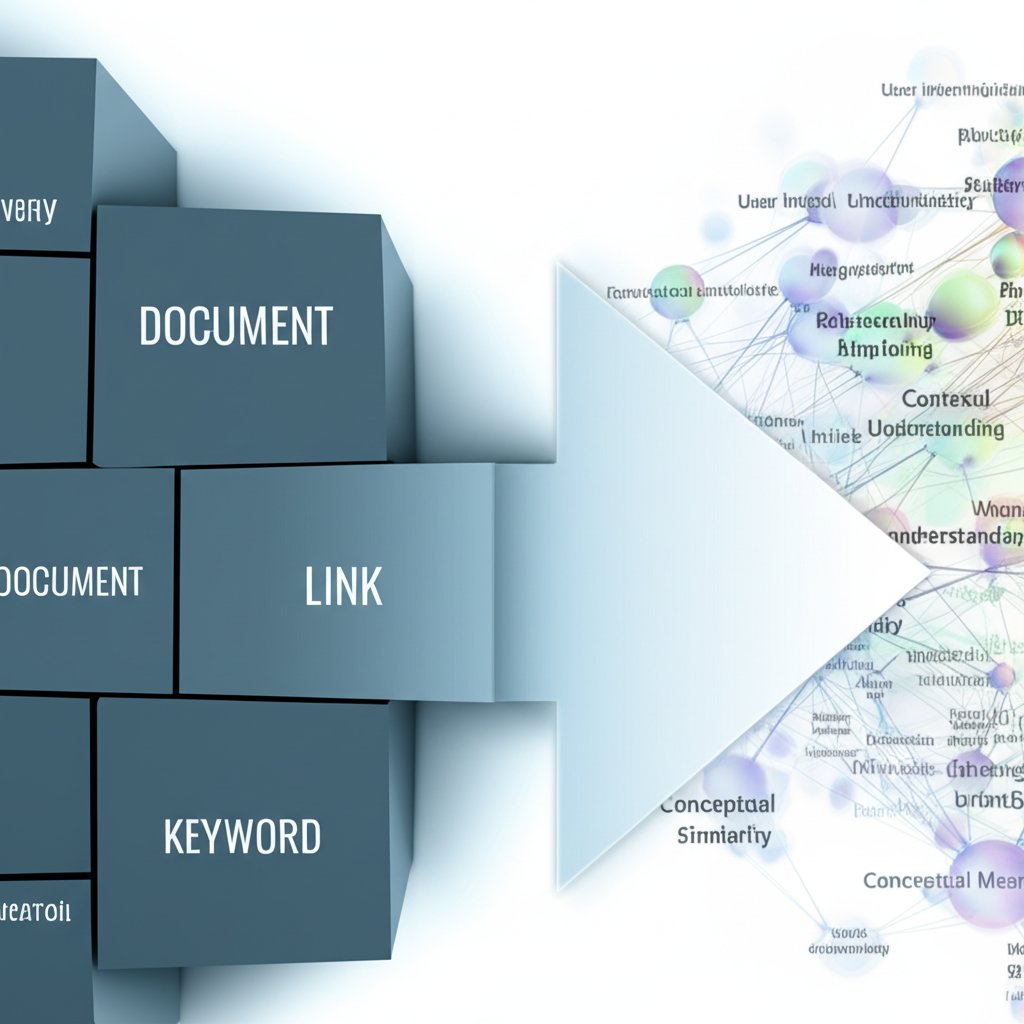
The most profound change introduced by the Hummingbird update was the transition from keyword matching to semantic search. Before Hummingbird, search engines largely operated by finding pages that contained the exact keywords a user typed. This led to an SEO environment where keyword density was a major focus. Hummingbird revolutionized this by enabling Google to understand concepts and the relationships between them, a process powered by its growing Knowledge Graph, which had been introduced a year earlier.
Semantic search allows the engine to interpret the intent behind a query, even when it's not explicitly stated. For instance, as explained by Moz, a query for 'best place for chinese' is understood to be a search for local Chinese restaurants, not a query about living in China. Hummingbird applied this contextual understanding to billions of web pages, making search results dramatically more relevant. It could now identify and even disregard superfluous words in a query—like 'my dear' in a voice search—to focus on the core meaning, a capability that was foundational for the rise of voice assistants and conversational search.
This shift was a necessary evolution for a world increasingly dominated by mobile devices, where users were more likely to use longer, spoken queries. The ability to understand natural language became paramount. The update allowed Google to move beyond simple word recognition and start a true 'conversation' with the user, providing answers that matched the meaning, not just the words.
| Aspect | Keyword Matching (Pre-Hummingbird) | Semantic Search (Post-Hummingbird) |
|---|---|---|
| Focus | Matching individual words in the query to words on a page. | Understanding the context and intent of the entire query. |
| Query Type | Optimized for short, specific keyword phrases. | Effective for long-tail, conversational, and voice queries. |
| Result Quality | Could return irrelevant pages that happened to contain the keywords. | Delivers more relevant results that match the user's true intent. |
| SEO Strategy | Focused heavily on keyword density and exact-match keywords. | Emphasizes topic authority, natural language, and user experience. |
By learning to parse the meaning behind queries, Hummingbird laid the architectural groundwork for Google to become more intelligent. It was no longer just a database of indexed pages but an information engine capable of understanding real-world entities and their connections. This conceptual understanding was the key that unlocked a more intuitive and helpful search experience for everyone.
Optimizing for Hummingbird: The Lasting Impact on SEO Strategy
The Google Hummingbird update fundamentally changed the playbook for search engine optimization. It signaled the end of optimizing for keywords and the beginning of optimizing for people. Because the algorithm could now understand context and intent, old tactics like keyword stuffing became ineffective. The new focus was on creating high-quality, comprehensive content that thoroughly answered the questions users were asking. This shift meant that white-hat SEOs who were already focused on creating valuable content didn't need to make drastic changes.
The primary directive for content creators became to focus on topics, not just isolated keywords. Instead of building dozens of pages to target slight variations of a keyword phrase (e.g., 'best running shoes,' 'top running shoes,' 'good running shoes'), the post-Hummingbird strategy was to create a single, authoritative page that covered the topic of running shoes in depth. This approach naturally incorporates long-tail keywords and related concepts, signaling to Google that the page is a comprehensive resource that satisfies user intent from multiple angles. Marketers looking to scale this type of high-quality, intent-focused content can leverage advanced tools. For instance, creators can use an AI blog post generator like BlogSpark to transform ideas into SEO-optimized articles, ensuring the output aligns with modern search engine principles by focusing on natural language and comprehensive topic coverage.
To align with the principles established by Hummingbird, content strategy should be built around the following best practices:
- Use Natural, Conversational Language: Write for humans, not search engine bots. Address user questions in a clear, direct, and natural tone.
- Focus on Topics and Intent: Research what your audience is truly looking for. Use tools like 'People Also Ask' and 'Related Searches' to understand their pain points and questions.
- Incorporate Long-Tail Keywords: Naturally weave in longer, more specific search phrases that reflect how people actually search and speak.
- Utilize Schema Markup: Implement structured data to help search engines understand the context of your content, such as identifying recipes, events, or products.
Here are actionable steps for creating content in a post-Hummingbird world:
- Conduct Deep User Intent Research: Go beyond keywords to understand the 'why' behind the search. Is the user looking to buy, learn, or find something specific?
- Structure Content Logically: Organize your content with clear headings and subheadings (H2s, H3s) to create a logical flow that answers a user's primary query and any follow-up questions.
- Write Comprehensively: Cover a topic from all relevant angles. Use synonyms, related concepts, and answer related questions within a single piece of content.
- Prioritize User Experience: Ensure your website is mobile-friendly, fast-loading, and easy to navigate. A positive user experience reinforces the quality of your content.

The Legacy of Hummingbird: Paving the Way for RankBrain and BERT
The Hummingbird update was more than just an improvement; it was a foundational restructuring that paved the way for Google's future advancements in artificial intelligence and machine learning. By rebuilding its core algorithm to understand semantic context, Google created the necessary architecture for more sophisticated systems like RankBrain and BERT to function effectively. Hummingbird taught the engine the rules of language and meaning, while later updates would use AI to master nuance and intent at an unprecedented scale.
RankBrain, introduced in 2015, was Google's first major AI-based machine learning system used to help process search results. It excelled at interpreting ambiguous or novel queries that Google had never seen before. Hummingbird provided the contextual framework, and RankBrain used machine learning to make intelligent guesses about the user's intent within that framework. It learned to associate unfamiliar long-tail queries with more common ones, improving results for about 15% of all searches.
Years later, the BERT (Bidirectional Encoder Representations from Transformers) update represented another massive leap forward. As detailed by sources like Page One Power, BERT can understand the full context of a word by looking at the words that come before and after it. This is particularly powerful for understanding how prepositions like 'for' and 'to' can completely change the meaning of a query. Hummingbird set the stage by moving beyond keywords, and BERT perfected this by understanding the subtle relationships between all the words in a sentence.
| Algorithm Update | Primary Function | Analogy |
|---|---|---|
| Hummingbird (2013) | Rewrote the core algorithm to understand the context of the entire query. | Learning the rules of grammar and sentence structure. |
| RankBrain (2015) | Used machine learning to interpret novel and ambiguous queries. | Gaining the ability to infer meaning and handle unfamiliar slang. |
| BERT (2019) | Analyzed the full context of words in relation to each other. | Achieving a deep understanding of nuance, idiom, and implied meaning. |
Ultimately, the principles that defined success after the Hummingbird update—creating clear, comprehensive, and user-focused content—are more critical today than ever. These practices don't just satisfy one specific algorithm; they form the foundation of a robust SEO strategy that aligns with Google's long-term goal: to understand language as well as a human does. Hummingbird was the revolutionary first step on that journey.
Frequently Asked Questions
1. What is a Hummingbird in SEO?
In the context of SEO, Hummingbird refers to a major Google search algorithm update from 2013. It was a complete rewrite of the core algorithm designed to better understand the full meaning and context of search queries, shifting the focus from individual keywords to natural, conversational language and user intent.
2. What is an example of the Hummingbird algorithm?
A classic example provided by Google involved the query 'pay your bills through citizens bank and trust bank.' Before Hummingbird, search results might have just shown the homepage for the bank. After the update, Google was better able to understand the user's specific intent and would instead return the direct page for paying bills, providing a much more relevant and efficient result.
3. What is the Hummingbird optimization algorithm?
There is no specific 'Hummingbird optimization algorithm' for SEOs to manipulate. Optimizing for Hummingbird simply means aligning with its principles: creating high-quality, comprehensive content that directly answers user questions in natural language. The strategy is to focus on topical authority and user intent rather than technical tricks or keyword density.
4. What is the Hummingbird update on Google?
The Hummingbird update was a complete overhaul of Google's search algorithm that went live in August 2013. Its main goal was to improve semantic search, allowing Google to more accurately interpret the intent behind users' queries and provide more relevant results, especially for complex or conversational searches.