

TL;DR
To identify key words, you must first extract the essential concepts from your topic or research question. This involves brainstorming the most important terms, listing synonyms and related phrases for each concept, and then combining them to search for information. This process is crucial for finding relevant sources in academic databases and for optimizing online content to attract the right audience through search engines.
What Are Keywords and Why Are They Important?
At its core, identifying keywords is the process of translating a complex idea into a language that search systems—whether a library database or Google—can understand. It’s the foundational step for any successful research project. A clear distinction is often made between keywords and key phrases. According to academic guides, a keyword is typically a single word representing a core concept, while a key phrase combines two or more words to create a more specific search term. For example, 'social media' is a key phrase that is far more descriptive than the single keyword 'media'.
The importance of this process cannot be overstated. In academic research, well-chosen keywords unlock access to relevant articles, books, and studies that form the backbone of your work. They act as a bridge between your research question and the vast archives of scholarly knowledge. Without the right terms, you might miss critical literature or waste hours sifting through irrelevant results. This methodical approach ensures your research is both efficient and comprehensive.
In the digital world of SEO (Search Engine Optimization), keywords serve a similar but commercially vital function. They are the terms people type into search engines when looking for information, products, or services. By identifying and using these keywords in your website content, you connect your offerings to a user's query, driving targeted traffic to your site. Understanding the language of your audience is the first step toward visibility and engagement online.
A Step-by-Step Guide to Identifying Your Keywords
Finding the right keywords is a systematic process of brainstorming, testing, and refining. It’s less about guessing and more about a structured approach to deconstructing your topic into its essential components. By following a clear set of steps, you can build a powerful list of terms to guide your research. The following process, adapted from methods used by university libraries, provides a reliable framework for any topic.
- Describe Your Research Topic: Start by writing a one or two-sentence description of your topic. Phrasing it as a question you want to answer is an excellent strategy. For instance, your research question might be: "Does social media interaction in online classes help college students learn?" This sentence provides the raw material for the next steps.
- Identify the Main Concepts: From your description, pull out the 2-4 most important words or phrases. These are your core concepts. In the example above, the core concepts are: 'college students', 'online classes', 'social media', and 'help learn'. These terms represent the pillars of your research question.
- Brainstorm Synonyms and Related Terms: For each core concept, create a list of alternative keywords. This is where you expand your reach. Think about synonyms, different phrasings, and more specific examples. For instance:
- College students: undergraduates, university students, adult learners
- Online classes: distance education, e-learning, remote learning
- Social media: social networking, Facebook, TikTok, Instagram
- Help learn: academic success, performance, grades, engagement
- Test and Refine Your Keyword Combinations: Begin searching using one keyword from each concept list, connected by "AND" (e.g., undergraduates AND e-learning AND TikTok AND grades). Analyze the results. If you get too few results, broaden your search by using fewer or more general keywords. If you get too many, narrow it by adding more specific terms. As you review relevant articles, pay attention to the terminology used by authors and add any new, relevant terms to your lists. According to a detailed guide from American Public University System, this iterative process of testing and refining is key to honing in on the most effective keywords.
Advanced Techniques for Keyword Expansion
Once you have a foundational list of keywords, you can employ more advanced techniques to uncover less obvious terms and deepen your research. These strategies help you think more broadly and creatively about your topic, ensuring you capture a wider range of relevant information and user intents. Moving beyond basic synonyms can reveal valuable long-tail keywords—longer, more specific phrases that often have less competition and higher relevance.
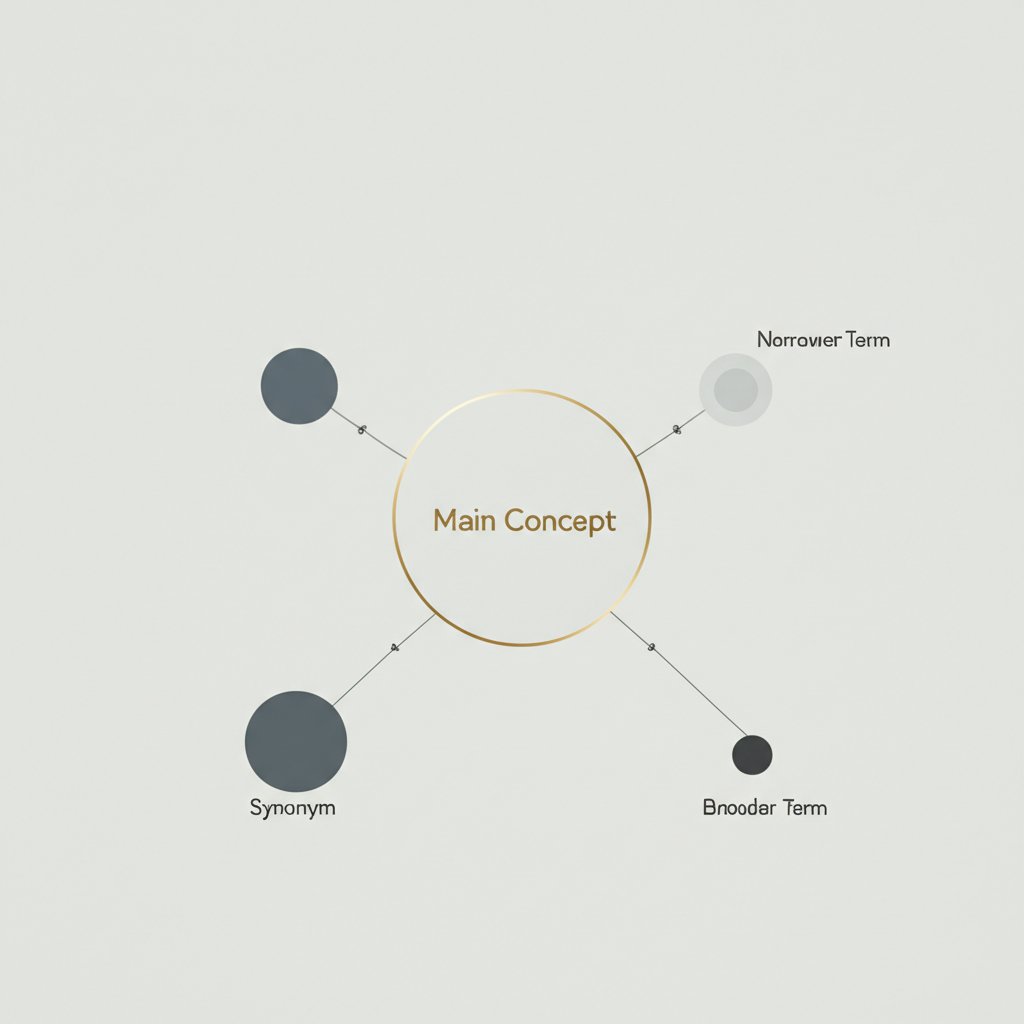
One effective method is to think in terms of broader, narrower, and related concepts. This helps you navigate the hierarchy of your topic. For example, if your core topic is 'cat food', you can explore:
- Broader terms: pet supplies, animal nutrition
- Narrower terms: grain-free kitten food, senior cat wet food
- Related terms: feline health, veterinary diets, pet food recalls
Other creative brainstorming techniques can also yield excellent results. Use a thesaurus to find synonyms you hadn't considered. Another powerful, yet simple, technique is to find images related to your topic and write down words that describe them. This visual approach can trigger different vocabulary and concepts. Furthermore, conducting quick background research on your topic in encyclopedias or introductory articles can help you note the standard terminology used by experts in the field, adding authoritative terms to your list.
Leveraging Keyword Research Tools
While manual brainstorming is essential for understanding the concepts behind your topic, keyword research tools provide invaluable data to refine and prioritize your list. These tools analyze search engine data to show you what terms people are actually using, how often they search for them (search volume), and how difficult it might be to rank for those terms (competition). This data-driven approach is a crucial supplement to your conceptual work.
Several types of tools are available, from free options to comprehensive professional suites. For instance, the Google Keyword Planner is a free tool designed for advertisers but widely used for SEO research to get strategic suggestions. Other popular tools like WordStream and Wordtracker offer free versions that can help you discover thousands of profitable long-tail keywords. These platforms can take a single 'seed' keyword and generate hundreds of related ideas you may not have thought of on your own.
For those looking to integrate keyword discovery into a larger content creation workflow, AI-powered platforms are changing the game. For example, marketers and creators can use tools like BlogSpark to not only discover relevant keywords but to transform those ideas into SEO-optimized articles. Such platforms streamline the entire process, from intelligent outlining to ensuring content originality, freeing up teams to focus on broader strategy.
Here is a brief overview of the types of tools mentioned:
| Tool Type | Primary Function | Example(s) |
|---|---|---|
| Classic Keyword Finders | Provide search volume, competition data, and keyword suggestions. | Google Keyword Planner, WordStream, Wordtracker |
| NLP Keyword Extractors | Automatically pull the most relevant keywords from a block of text or URL. | Cortical.io's Free Tool |
| AI Content Platforms | Integrate keyword research with content generation and optimization. | BlogSpark |

From Concepts to Clarity: Mastering Your Keywords
Ultimately, the ability to identify key words is a fundamental skill for navigating the information age. It's a blend of art and science—requiring both creative brainstorming and analytical refinement. Whether you are a student embarking on a research paper or a digital marketer developing a content strategy, mastering this process is the first step toward achieving your goals. Remember that keyword research is not a one-time task but an ongoing cycle of discovery, testing, and adaptation. By consistently applying these principles, you can ensure your message always connects with the right audience.
Frequently Asked Questions
1. How can I find the key words?
You can find keywords by first brainstorming the main concepts of your topic. From there, you can expand your list with synonyms and related terms. For a data-driven approach, you can use a keyword finder tool like Google Keyword Planner or WordStream, which provide ideas based on actual search data and suggest keywords your competitors might be using. [cite:peopleAlsoAsk]
2. How do you identify a key term?
To identify a key term, start by examining your research question or topic sentence. Look for the essential nouns or noun phrases that define what your topic is about. [cite:peopleAlsoAsk] These are the core concepts that hold your question together. For example, in the question "What is the impact of remote work on employee productivity?", the key terms are 'remote work' and 'employee productivity'.
3. What are some examples of key words?
Key words are not necessarily the most frequent words in a text, but the ones that are most unusually frequent for that specific topic. [cite:peopleAlsoAsk] For example, in an article about a housing dispute, common words like 'the' and 'a' are frequent but not key. The key words would be terms like 'squatter', 'council', and 'breakage' because their frequency is specific and meaningful to that particular subject.