

TL;DR
To increase your Ahrefs Domain Rating (DR), you must focus on acquiring high-quality, 'followed' backlinks from unique and authoritative websites. The core strategy involves creating valuable, non-commercial content, known as 'linkable assets,' that other sites naturally want to cite. The strength of your backlink profile, not the sheer quantity of links, is the primary driver of DR growth.
Understanding Ahrefs Domain Rating (DR)
Before diving into strategies, it's crucial to understand what Ahrefs Domain Rating (DR) is and how it functions. DR is a proprietary Ahrefs metric that measures the relative strength of a website's backlink profile on a logarithmic scale from 0 to 100. This logarithmic nature means that moving from DR 10 to 20 is significantly easier than moving from DR 70 to 80. It's a measure of 'link popularity' rather than a direct Google ranking factor.
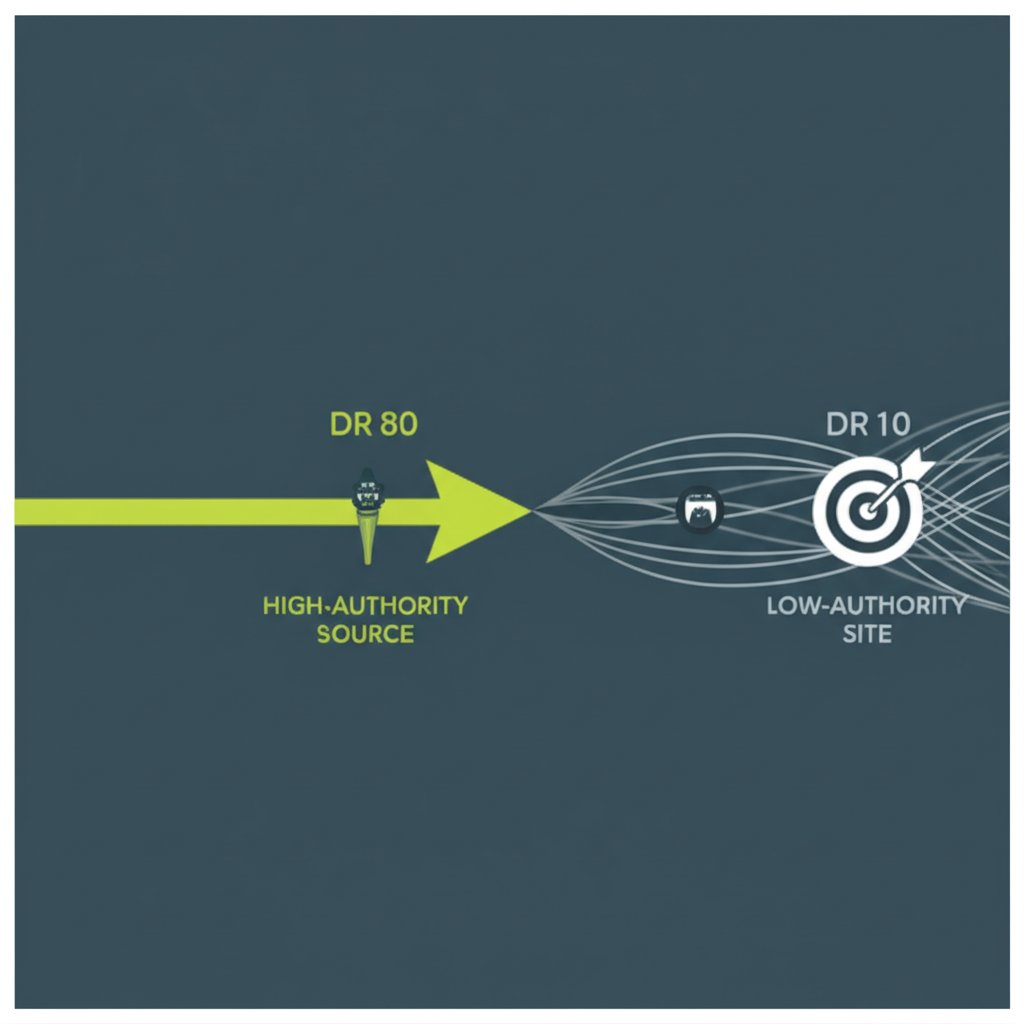
The calculation of DR is nuanced and rests on several key principles. It's not just about how many sites link to you, but about the quality and context of those links. According to Ahrefs' own explanation, the metric is primarily influenced by the DR of the domains linking to you and how many other unique websites those domains link out to. A link from a high-DR site that links to thousands of other sites will pass less 'DR equity' than a link from a site with a similar DR that links out to very few.
Here are the core principles that govern the DR calculation:
- 'Followed' Links Only: Only 'dofollow' links are considered in the calculation. Links with 'nofollow,' 'sponsored,' or 'UGC' attributes do not contribute to your DR.
- Unique Domains Matter: Only the first 'followed' link from a unique website increases your DR. Subsequent links from that same domain will not provide any additional DR boost.
- Link Equity Dilution: The amount of DR value a link passes is divided among all the unique domains that site links to. Therefore, a link from a high-authority site with few external links is more potent than one from a site that links out prolifically.
- DR is Relative: Your DR can drop even if you don't lose any backlinks. As other websites in the Ahrefs database gain more high-quality links, the entire scale can shift, pushing your relative score down.
Understanding these mechanics is essential for building an effective strategy. The goal isn't just to get links, but to get the right kind of links from the right kind of websites—those that are authoritative and selective about who they link to.
The Anatomy of a High-Impact Backlink
The cornerstone of increasing your Domain Rating is acquiring high-impact backlinks. Not all links are created equal; some can significantly move the needle on your DR, while others have a negligible effect. A high-impact backlink is one that comes from a reputable, relevant website that signals trust and authority to search engines and, by extension, to Ahrefs' algorithm.
To identify and pursue these valuable links, you must evaluate potential link sources against a clear set of criteria. Synthesizing insights from SEO experts at Backlinko and Ahrefs, a high-quality backlink possesses several key attributes. Firstly, the linking domain should have a strong DR score itself. Secondly, the link must be a 'followed' link to pass authority. Thirdly, the linking website should be topically relevant to your own, as this signals contextual authority. Finally, and crucially, links from sites with fewer outbound links are more valuable because their 'link equity' is less diluted.
To make this distinction clearer, consider the following comparison:
| Attribute | High-Impact Link | Low-Impact Link |
|---|---|---|
| Linking Domain's DR | High (e.g., DR 50+) | Low (e.g., DR <20) |
| Link Attribute | 'Followed' | 'Nofollowed' or 'Sponsored' |
| Topical Relevance | High (Same or related industry) | Low (Unrelated topic) |
| Number of Outbound Links | Low (e.g., <100) | Very High (e.g., 10,000+) |
| Link Placement | In-content, editorial | Footer, sidebar, or directory |
A practical takeaway from this is to prioritize outreach to websites that are not just high-DR but also discerning in their linking practices. As noted by Stan Ventures, targeting mid-range DR sites (e.g., DR 30-40) with very few outbound links can be a more effective strategy than chasing only the highest DR domains that link out extensively.
Creating Linkable Assets to Attract Authority
The most sustainable way to earn high-impact backlinks is by creating 'linkable assets'—pieces of content that other websites want to link to because they provide exceptional value. Instead of solely relying on outreach to ask for links, this strategy focuses on creating content that pulls links in organically. A linkable asset is typically non-commercial and serves to inform, educate, or provide utility.
There are several proven types of linkable assets that consistently attract authoritative links. One of the most effective is data-driven content. This includes original research, industry studies, and curated statistics pages. As demonstrated by Ruler Analytics, creating a benchmark report from their own app data generated hundreds of valuable backlinks. Similarly, creating comprehensive stats pages on trending topics provides journalists and bloggers with citable data, making your page a go-to resource.
Another powerful type of linkable asset is utility content. This includes free tools, calculators, templates, or any resource that helps users solve a specific problem. Ahrefs' own free backlink checker is a prime example, having attracted thousands of links because of its inherent usefulness. The key is to provide a solution or resource so valuable that other sites feel compelled to share it with their audience.
Finally, producing citable expert insights and unique ideas can establish your site as a thought leader and attract links. This involves publishing content that presents a novel perspective, a deep analysis, or a comprehensive guide that becomes the definitive resource on a topic. When you become the source for a key concept in your industry, other creators will reference and link back to your work.
Developing this kind of high-quality content requires significant effort in research, writing, and design. To streamline the initial drafting and optimization process, marketers can leverage advanced tools. For instance, platforms like BlogSpark can help generate SEO-optimized article frameworks and drafts, allowing content teams to focus their energy on incorporating unique data, expert insights, and the creative elements that transform a standard blog post into a powerful linkable asset.
Executing a Strategic Link Building Campaign
Creating a fantastic linkable asset is only half the battle. Without proactive promotion and outreach, even the best content can go unnoticed. A strategic link-building campaign ensures your asset gets in front of the right people—those who have the ability and motivation to link to it. The goal is to connect your valuable resource with creators who will find it useful for their own audiences.
The first step is to identify your link prospects. These are the websites and individuals you will reach out to. A highly effective method is to find websites that have already linked to similar, but perhaps less comprehensive, content. You can use tools like Ahrefs' Site Explorer to analyze the backlink profiles of articles on similar topics. The list of sites linking to them is your initial outreach list. Another approach is to find people who have recently written about your topic. A simple Google search or content exploration tool can reveal relevant articles, and from there, you can identify the authors to contact.
Once you have a list of prospects, the next step is to conduct outreach. Your outreach email should be concise, personal, and value-driven. Avoid generic, spammy templates. Instead, briefly introduce yourself, explain why you're contacting them specifically (e.g., you enjoyed their recent article on a related topic), and then present your linkable asset as a resource they might find valuable. The key is to frame it as a helpful suggestion, not a demand for a link. Here is a simple template to consider:
Subject: Quick thought on your [Topic] article
Hi [Name],
I was just reading your article on [Article Topic] and really enjoyed your point about [Specific Detail].
It reminded me of a data study we recently published on [Your Asset's Topic], which found that [Interesting Stat or Finding].
Thought it might be a useful resource for you or your readers. No pressure to share, just wanted to pass it along!
Best,[Your Name]
Finally, don't forget the power of internal linking. Once you've earned authoritative backlinks to your linkable asset, you can pass some of that 'link equity' to your important commercial or product pages. By strategically adding internal links from your high-authority asset to relevant product or service pages, you help distribute that authority across your site, which can improve the ranking potential of those pages.

Frequently Asked Questions About Domain Rating
1. What is a good domain rating in Ahrefs?
There is no absolute 'good' Domain Rating. DR is a relative metric, meaning its value depends on the competitive landscape of your niche. A DR of 30 might be excellent for a small, niche industry, while a DR of 70 could be average in a highly competitive space like digital marketing. A useful rule of thumb is to compare your DR to that of your direct competitors. If your DR is higher or comparable, you are in a strong position.
2. How is Domain Rating different from URL Rating?
Domain Rating (DR) measures the overall authority of an entire website based on its complete backlink profile. In contrast, URL Rating (UR) measures the strength of a single, specific page's backlink profile. A page can have a high UR even if the website's overall DR is low, especially if that specific page has attracted many high-quality backlinks. Increasing the UR of key pages by building direct links to them is often more impactful for ranking than focusing solely on increasing the overall DR.