
TL;DR
A marketing funnel is a strategic model that visualizes the customer's journey, from their first moment of awareness about a brand to the final action of making a purchase. Its core purpose is to help businesses understand and optimize the process of converting potential leads into loyal customers by tailoring marketing strategies to specific stages of their journey, such as awareness, consideration, and conversion. This framework makes the customer path measurable, allowing companies to identify drop-off points and refine their approach for better results.
What Is a Marketing Funnel? Understanding the Customer Journey
A marketing funnel is a foundational concept that illustrates the theoretical path a potential customer takes from learning about a product or service to becoming a paying customer. First associated with the AIDA model (Awareness, Interest, Desire, Action) in the early 20th century, this framework helps businesses visualize and structure their marketing efforts. The metaphor of a funnel is used because marketers start by targeting a wide audience at the top, which gradually narrows as people move through the stages, with a smaller group ultimately making a purchase at the bottom. The primary benefit of using a marketing funnel is that it simplifies the complex customer journey, making it easier for companies to follow and analyze.
The core purpose of the marketing funnel is to provide a structured way for businesses to guide potential customers toward a conversion. By mapping out each stage of the client's decision-making process, companies can plan specific tactics to influence consumers effectively. According to Sprout Social, this model allows businesses to know what they must do to engage consumers at certain stages, potentially leading to greater sales and stronger brand awareness. It's a powerful tool for bringing visibility to every step of connecting with a customer, from the initial touchpoint to the final sale and beyond.
In today's digital landscape, the customer journey is rarely a straight line. Modern digital marketing funnels account for the fact that consumers can enter, exit, and re-enter the funnel at various points. As noted by Amazon Ads, the digital path to purchase is anything but linear, with the consideration phase alone involving extensive online research and comparison. Brands have adapted to this by embracing a less rigid model, focusing on connecting with customers in authentic ways across all potential touchpoints.
It's also important to distinguish between a marketing funnel and a sales funnel. While often used interchangeably, they represent two parts of a whole. The marketing function is responsible for brand building, generating awareness, and driving qualified leads into the top of the funnel. The sales function, on the other hand, focuses on converting those leads into customers at the bottom of the funnel. A seamless handoff and constant communication between marketing and sales teams are crucial for success, ensuring that leads are properly nurtured and guided toward a purchase decision.
The Stages of the Marketing Funnel: From Awareness to Advocacy
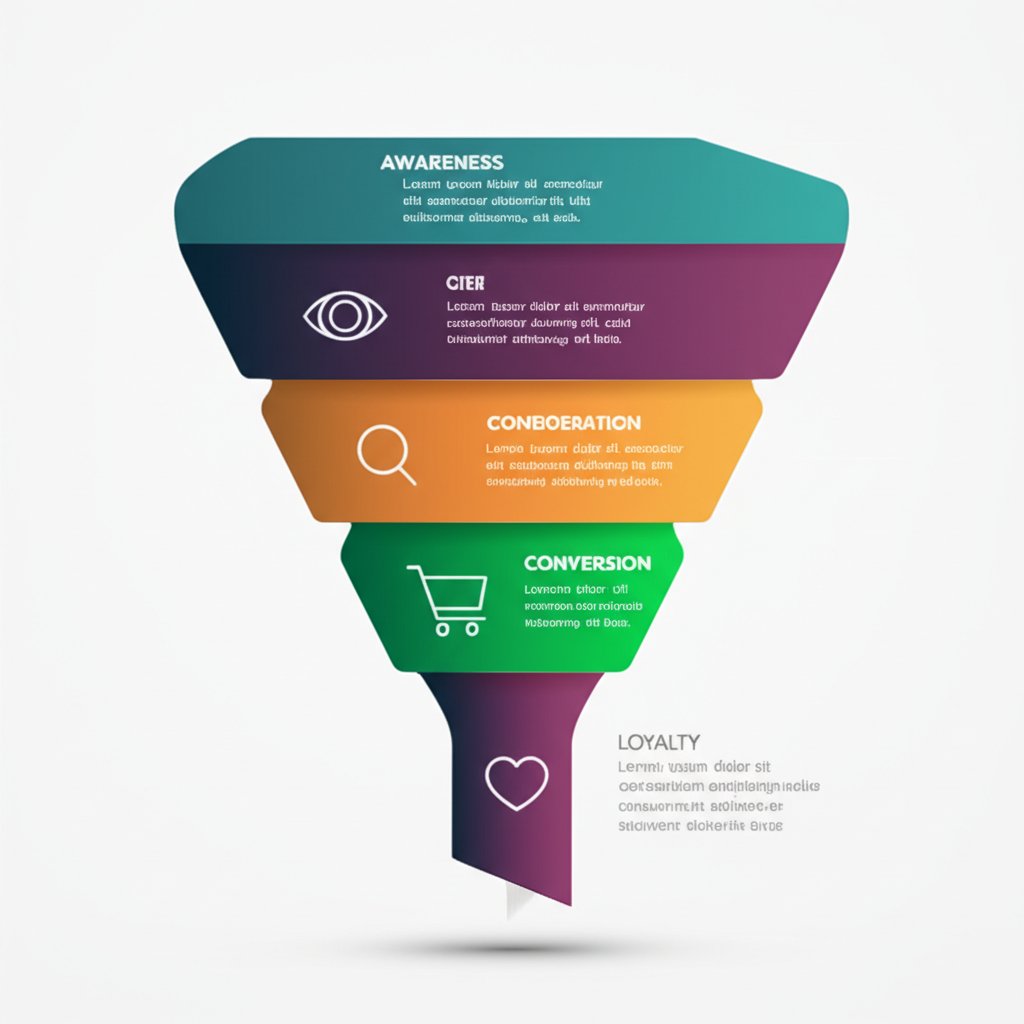
To effectively guide a customer from a stranger to a brand advocate, the marketing funnel is broken down into distinct stages. While different models exist, a common and comprehensive framework includes four key phases: Awareness, Consideration, Conversion, and Loyalty. Each stage represents a different mindset for the customer and requires a unique set of marketing tactics to successfully move them to the next phase. Understanding these stages allows marketers to deliver the right message at the right time, building a relationship based on trust and value.
The journey begins at the Top of the Funnel (TOFU) with the Awareness stage. Here, the primary goal is to attract a wide audience and introduce them to your brand. Potential customers at this stage are just becoming aware of a problem or need and are starting to look for solutions. Marketing efforts are focused on generating interest and sharing information, not on making a hard sell. The objective is to cast a wide net and capture the attention of anyone who could potentially become a customer, establishing your brand as a helpful resource in their minds.
Next is the Middle of the Funnel (MOFU), which encompasses the Consideration stage. Once a lead has become aware of your brand, they move into a phase of evaluation. They are actively researching and comparing different options to solve their problem. As Adobe explains, marketing at this stage should provide more detailed information to build purchasing intent. This is where you nurture leads by demonstrating your expertise and showing what differentiates your product from the competition. The goal is to build trust and position your solution as the best choice.
The Bottom of the Funnel (BOFU) is where the Conversion and Loyalty stages happen. In the Conversion (or Action) stage, the prospect is ready to make a purchase. They have done their research and believe your brand offers the right solution. Marketing efforts here should make the purchasing process as simple and frictionless as possible. After the sale, the focus shifts to Loyalty and Advocacy. Retaining existing customers is often more cost-effective than acquiring new ones. This final stage involves nurturing the customer relationship through excellent service, loyalty programs, and ongoing engagement to turn one-time buyers into repeat customers and enthusiastic brand advocates who bring new prospects into the top of your funnel.
| Funnel Stage | Customer Mindset | Marketing Goal | Common Tactics & Channels |
|---|---|---|---|
| Awareness (TOFU) | "I have a problem or need, and I'm looking for information." | Attract a broad audience and build brand awareness. | Blog Posts, SEO, Social Media Campaigns, Infographics, Videos, Podcasts. |
| Consideration (MOFU) | "I'm comparing different solutions and brands to solve my problem." | Nurture leads and build trust by providing valuable, detailed information. | Webinars, Case Studies, In-depth eBooks, Email Campaigns, Customer Reviews. |
| Conversion (BOFU) | "I'm ready to buy and have chosen a specific product or service." | Make the purchase process easy and encourage the final decision. | Free Trials, Demos, Optimized Landing Pages, Special Offers, Customer Testimonials. |
| Loyalty & Advocacy | "I had a great experience and trust this brand for future needs." | Retain customers and encourage them to become brand promoters. | Loyalty Programs, Follow-up Emails, Personalized Communication, Surveys. |
How to Build & Measure a High-Converting Marketing Funnel
Building an effective marketing funnel requires a strategic approach that aligns content and channels with the customer's needs at each stage. It's about more than just understanding the theory; it's about putting a practical plan into action. This involves defining your audience, creating a content map, driving traffic, nurturing leads, and measuring your results to continuously optimize performance. A well-constructed funnel acts as a predictable engine for growth, turning prospects into customers systematically.
Follow these steps to create and manage your marketing funnel:
- Define Your Target Audience: Before you can attract anyone, you need to know who you're talking to. Develop detailed buyer personas based on demographic data, company information, and behavioral patterns. Understanding your ideal customer's pain points and motivations is the foundation for crafting resonant messaging.
- Create a Content Plan for Each Stage: Content is the fuel for your funnel. Map out different types of content that align with each stage. For the awareness stage, focus on educational blog posts and social media. For consideration, use detailed case studies and webinars. At the conversion stage, offer demos and free trials. To efficiently scale your content creation for every stage, tools like AI blog post generators can be invaluable. For instance, marketers looking to streamline this process can use a platform like BlogSpark to quickly produce engaging, SEO-optimized articles, freeing up time for strategic planning.
- Drive Traffic to the Top of the Funnel: Once you have your content, you need to get it in front of your audience. Use a mix of inbound marketing strategies like SEO to rank in search results, social media marketing to engage communities, and digital PR to earn media coverage. The goal is to drive as many qualified prospects into the top of your funnel as possible.
- Nurture Leads in the Middle: Most leads aren't ready to buy immediately. Use marketing automation tools to nurture them with targeted email campaigns and personalized content. Lead scoring—a system for ranking leads based on their engagement and fit—can help your sales team identify which prospects are most promising and ready for a direct interaction, as suggested by Semrush.
- Convert and Retain Customers: At the bottom of the funnel, focus on making the purchase process seamless. After the sale, the work isn't over. Implement customer retention strategies like loyalty programs and follow-up communication to foster long-term relationships and encourage repeat business.
Measuring the success of your funnel is critical for optimization. Track key metrics at each stage to identify leaks where you're losing customers. Important metrics include:
- Conversion Rate (CVR): The percentage of users who move from one stage to the next. This helps you assess the performance of individual channels and content pieces.
- Cost Per Acquisition (CPA): The total cost of acquiring a new customer, from the first touchpoint to conversion.
- Customer Lifetime Value (LTV): The total revenue you can expect from a single customer account. A high LTV indicates strong customer retention and loyalty.

Beyond the Traditional Funnel: The Rise of the Flywheel
While the marketing funnel has been a cornerstone of strategy for over a century, its linear, top-down model has faced criticism in the modern digital age. Today's customer journey is far more complex and cyclical. Consumers interact with brands across countless touchpoints, entering the buying process at various stages and often moving in non-linear ways. This has led many to question if the traditional funnel is still relevant, with some even declaring that the marketing funnel is dead. The primary critique is that the funnel treats customers as an output, focusing solely on the conversion and neglecting the post-purchase experience.
In response to these limitations, a new model has gained prominence: the marketing flywheel. Popularized by HubSpot, the flywheel places the customer at the center of the business. Unlike the funnel, which loses energy once a customer is acquired, the flywheel is designed to build and maintain momentum. It focuses on using the energy of satisfied customers to drive referrals and repeat sales. The model is built on three phases: Attract, Engage, and Delight. By consistently delighting customers, businesses create brand advocates who then help attract new prospects, keeping the wheel spinning with increasing speed.
The fundamental difference lies in their approach to the customer. The funnel views customers as the end result of a process, while the flywheel sees them as a driving force for growth. This shift has significant implications for business strategy, encouraging companies to invest more in customer service, success, and community-building to create exceptional experiences that fuel growth organically.
| Aspect | Marketing Funnel | Marketing Flywheel |
|---|---|---|
| Model Shape | Linear (Top-to-Bottom) | Circular / Cyclical |
| Primary Focus | Customer Acquisition and Conversion | Customer Retention and Advocacy |
| View of Customers | An output at the end of the process | An input that fuels business growth |
| Energy Flow | Loses momentum after purchase | Builds and stores momentum over time |
Despite the rise of the flywheel, the marketing funnel is not obsolete. It remains an incredibly valuable framework for understanding and mapping the customer acquisition process. Many successful businesses use both models in conjunction. The funnel provides a clear structure for attracting and converting new leads, while the flywheel offers a powerful strategy for retention and long-term growth. The key is to see the funnel as part of a larger system—one that feeds into a customer-centric flywheel designed to create lasting relationships and sustainable momentum.
Frequently Asked Questions About the Marketing Funnel
1. What is the marketing funnel?
A marketing funnel is a model that describes a customer's journey with a brand. It maps the path from the initial stage of learning about the business to the final stage of making a purchase and becoming a loyal customer. It helps companies visualize and optimize the process of converting leads into customers at each step.
2. Why is the marketing funnel sometimes considered dead?
The traditional marketing funnel is often criticized for being too linear for today's complex customer journey. Modern customers interact with brands across multiple touchpoints and don't always follow a straight path from awareness to purchase. As a result, alternative models like the flywheel, which emphasizes customer retention and advocacy, have become popular for better reflecting this non-linear, cyclical reality.
3. What is the 3-stage funnel strategy?
The 3-stage funnel is a simplified model that breaks the customer journey into three main phases: Top of the Funnel (TOFU) for the awareness stage, Middle of the Funnel (MOFU) for the consideration stage, and Bottom of the Funnel (BOFU) for the conversion stage. This framework helps marketers create targeted strategies for attracting, nurturing, and converting leads.
4. What is the main purpose of using a funnel?
The primary purpose of a marketing funnel is to provide a strategic framework for understanding and managing the customer's purchasing journey. It allows marketers to identify which stage a customer is in and deliver the most relevant message or content. This targeted approach helps guide the customer toward a purchase more effectively and allows businesses to measure where they might be losing potential customers so they can improve their strategy.