
TL;DR
Funnel marketing provides a strategic framework for visualizing the customer journey. It models the process of guiding potential customers through a series of stages, starting from initial awareness of a brand and culminating in a purchase. The primary goal of a marketing funnel is to attract as many qualified leads as possible and systematically nurture them into loyal, paying customers.
What Is a Marketing Funnel? The Core Concept Explained
A marketing funnel is a consumer-focused model that illustrates the theoretical journey a customer takes toward purchasing a product or service. First conceptualized over a century ago, this model helps businesses understand and optimize the process of converting prospects into customers. The funnel analogy is used because a large number of potential customers start at the top (the widest part), and as they move through various stages, that number narrows down, with only a fraction making it to the final purchase stage at the bottom.
The fundamental purpose of the marketing funnel is to provide a structured approach to customer acquisition. By breaking down the customer journey into distinct phases, businesses can tailor their marketing strategies and messages to address the specific needs and mindset of consumers at each step. This structured view allows marketers to identify potential “leaks” or drop-off points where prospects lose interest or abandon the journey. Addressing these weaknesses helps to improve conversion rates and overall marketing efficiency.
Strategically, the marketing funnel is a cornerstone of modern marketing plans because it creates a predictable path for lead generation and nurturing. It helps businesses map out every stage of a client's decision-making process, from the first point of contact to post-purchase engagement. This clarity enables marketing teams to deploy the right tactics at the right time, ensuring that potential customers receive relevant information that guides them smoothly toward a purchase decision. Ultimately, a well-designed funnel transforms broad awareness into focused action and lasting customer loyalty.
The Key Stages of the Marketing Funnel
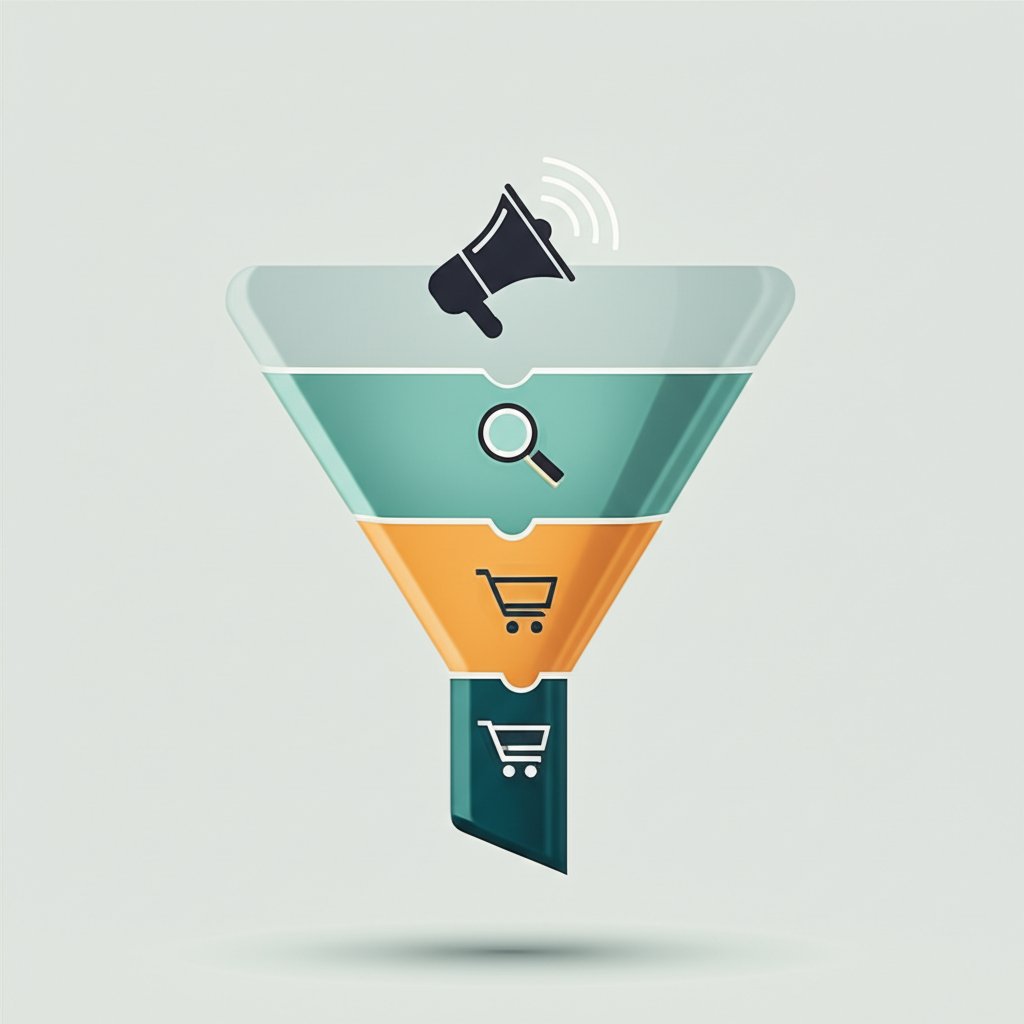
While various models exist, the marketing funnel is commonly broken down into several key stages, often categorized as Top of the Funnel (TOFU), Middle of the Funnel (MOFU), and Bottom of the Funnel (BOFU). Each stage corresponds to a different phase in the customer's mindset and requires distinct marketing tactics to be effective.
Top of the Funnel (TOFU): Awareness
The first stage is awareness, where the primary goal is to attract a wide audience and introduce them to your brand. At this point, potential customers are identifying a problem or need and are just beginning to research solutions. The key is to capture their attention and make them aware that your business exists. Marketing efforts here are focused on lead generation through broad-reaching content. Effective tactics include blog posts, social media campaigns, infographics, videos, and search engine optimization (SEO) to draw in organic traffic. For instance, creating high-quality, educational blog content is a powerful way to attract new visitors. Marketers and creators looking to scale their content production can revolutionize their workflow with tools like BlogSpark, an AI blog post generator that helps transform ideas into engaging, SEO-optimized articles in seconds.
Middle of the Funnel (MOFU): Interest and Consideration
Once a prospect is aware of your brand, they move into the middle of the funnel, which encompasses the interest and consideration stages. Here, potential customers are actively researching and evaluating different options to solve their problem. Your goal is to build a relationship with these leads, establish trust, and position your brand as the best solution. This is where lead nurturing becomes critical. Marketing tactics in this stage are more targeted and aim to educate the prospect further. Examples include in-depth case studies, white papers, webinars, email newsletters, and customer testimonials. According to Amazon Ads, this is the phase where you must inform customers how your product uniquely meets their needs.
Bottom of the Funnel (BOFU): Conversion and Action
The bottom of the funnel is where the decision-making happens. Prospects at this stage are ready to buy but may need a final nudge to take action. The marketing goal is to convert these highly qualified leads into paying customers. The offer you present must be compelling and the purchasing process must be as seamless as possible. Effective tactics include free trials, live demos, discount codes, detailed pricing pages, and clear, persuasive calls-to-action (CTAs). A simple and intuitive checkout process can significantly reduce purchase friction and prevent cart abandonment.
Post-Funnel: Loyalty and Advocacy
The journey doesn't end once a purchase is made. The final, and arguably most crucial, stage focuses on customer retention and loyalty. The goal is to turn one-time buyers into repeat customers and, ultimately, brand advocates. It costs significantly more to acquire a new customer than to retain an existing one, making this stage vital for sustainable growth. Strategies for fostering loyalty include loyalty programs, personalized post-purchase follow-ups, requests for feedback, and exclusive offers. Delighted customers are more likely to make future purchases and recommend your brand to others, feeding new prospects back into the top of your funnel.
Marketing Funnel vs. Sales Funnel: Clarifying the Key Differences
The terms "marketing funnel" and "sales funnel" are often used interchangeably, but they represent two distinct, yet connected, parts of the overall customer acquisition process. Understanding their differences is crucial for aligning marketing and sales teams to create a seamless customer experience from first contact to final purchase.
The marketing funnel is focused on the top-of-the-funnel activities. Its primary responsibility is to generate brand awareness and capture a large volume of leads. It casts a wide net to attract potential customers who are just beginning their journey, educating and nurturing them until they become qualified leads. The marketing team's job is to move prospects from being unaware of the brand to showing genuine interest in its products or services. The process ends when a lead is deemed "sales-qualified" and is handed off to the sales team.
In contrast, the sales funnel begins where the marketing funnel leaves off. It takes the qualified leads generated by marketing and guides them through the final stages of the decision-making process. The focus here is narrower and more personal, often involving direct interaction between the prospect and a sales representative. The goal of the sales funnel is to convert those leads into paying customers. While the marketing funnel deals with a one-to-many communication approach, the sales funnel is typically a one-to-one conversation aimed at closing the deal.
Though they have different objectives, the marketing and sales funnels are two halves of a single revenue-generation strategy. A smooth handoff between the two is essential for success. When marketing and sales teams are aligned, leads are better qualified, the customer experience is consistent, and conversion rates improve. The following table highlights the core distinctions:
| Aspect | Marketing Funnel | Sales Funnel |
|---|---|---|
| Primary Goal | Generate awareness and capture qualified leads | Convert qualified leads into paying customers |
| Focus | Attracting a broad audience and lead nurturing | Engaging specific prospects and closing deals |
| Typical Stages | Awareness, Interest, Consideration | Qualification, Proposal, Negotiation, Closing |
| Key Metrics | Website Traffic, Click-Through Rate (CTR), Cost Per Lead (CPL) | Conversion Rate, Customer Acquisition Cost (CAC), Deal Size |
Beyond the Traditional Funnel: The Rise of the Flywheel
For many years, the linear marketing funnel has been the dominant model for understanding the customer journey. However, in today's complex digital landscape, its limitations are becoming more apparent. Critics argue that the traditional funnel is too simplistic, as it treats customers as an output rather than a continuous part of the business cycle. The model's primary focus on acquisition often neglects the immense value of customer retention and advocacy, which are critical drivers of sustainable growth.
The modern customer journey is rarely a straight line. As noted by sources like Wikipedia, consumers now interact with brands across numerous touchpoints, entering and exiting the buying process at various stages. They might discover a product on social media, read reviews on a third-party site, visit the company's website, and then make a purchase in a physical store. This non-linear path has led to the development of alternative models that better reflect contemporary consumer behavior.
One of the most prominent alternatives is the flywheel model. Unlike the funnel, which loses energy once a customer is acquired, the flywheel is designed to build and maintain momentum. This model places the customer at the center and revolves around three key phases: Attract, Engage, and Delight. The core idea is that by providing an outstanding customer experience (Delight), you turn satisfied customers into promoters who then help attract new prospects and engage existing ones, thus spinning the flywheel faster.
The flywheel doesn't necessarily replace the funnel but rather evolves it. The funnel remains a useful tool for visualizing the customer acquisition process. However, the flywheel framework emphasizes that the journey doesn't end at the purchase. Instead, it creates a continuous loop where marketing, sales, and service teams all work together to keep customers happy. This focus on post-sale experience helps build powerful feedback loops—through reviews, referrals, and repeat business—that fuel future growth more efficiently than relying solely on top-of-funnel acquisition efforts.

Frequently Asked Questions About Funnel Marketing
1. What are funnels in marketing?
In marketing, a funnel is a strategic model representing the customer's journey from their first point of awareness about a product or brand to the final action of making a purchase. It's called a funnel because it typically starts with a large number of potential customers at the top, which gradually narrows down as they move through stages like awareness, interest, consideration, and conversion, with fewer people reaching the end. The purpose is to map out and optimize the marketing efforts at each stage to guide more prospects toward becoming customers.
2. Why is the traditional marketing funnel considered outdated by some?
The traditional marketing funnel is often criticized for being too linear and simplistic for today's complex customer journey. Modern consumers interact with brands across many different channels and touchpoints, and their path to purchase is rarely a straight line from awareness to action. Critics argue the funnel model excessively focuses on customer acquisition and neglects the crucial role of post-purchase loyalty and advocacy. As a result, alternative models like the flywheel have emerged, which place greater emphasis on customer experience and retention as drivers of sustainable growth.
3. Is Funnel a specific CRM?
While "funnel" is a general marketing concept, there is also a company named Funnel that provides a specific software platform. As seen in some search results, Funnel offers a marketing intelligence platform that helps businesses aggregate data from various marketing platforms for reporting and analysis. Additionally, another company also uses the name for a CRM and automation platform tailored for the real estate industry. It's important to distinguish between the universal marketing funnel model and these specific branded software solutions.