
TL;DR
To check if writing is AI-generated, the most effective approach combines technology and human judgment. Start by using free AI detector tools, which analyze text for robotic patterns, predictability, and unnatural sentence structures. For a more thorough assessment, complement these tools with manual checks, such as looking for a flawless but generic tone, factual inconsistencies, repetitive phrasing, and a lack of personal voice or nuanced analysis.
The Best AI Detector Tools: Your First Line of Defense
The rise of sophisticated large language models has made AI-generated text increasingly common. In response, a new class of software has emerged: AI content detectors. These tools are designed to be the first line of defense in identifying machine-written content. They work by analyzing text for specific characteristics that are hallmarks of AI, such as low 'perplexity' (how predictable the word choices are) and 'burstiness' (the variation in sentence length). Essentially, they are trained on massive datasets of both human and AI writing to recognize the subtle statistical patterns that differentiate them.
Several platforms have become leaders in this space, most offering free tiers for basic checks. Tools like GPTZero, Scribbr's AI Detector, and QuillBot's AI Detector provide a quick way to get a probability score on a piece of text. Many of these services can detect content from various models, including ChatGPT, Gemini, and Claude. Some, like Scribbr, even offer advanced features like paraphrasing detection to identify content that has been lightly edited by a human but originated from an AI.
While powerful, it's crucial to understand that these tools are not infallible. User experiences and even academic studies show their results can be inconsistent, sometimes producing false positives (flagging human work as AI) or false negatives (missing AI-generated text). For this reason, a high AI score should be seen as an indicator for further investigation, not as definitive proof. To get the most reliable results, follow a structured approach.
- Select a Reputable Tool: Start with one of the well-regarded detectors mentioned above.
- Paste the Full Text: For best results, analyze the entire document rather than small snippets, as the tool needs enough data to identify patterns.
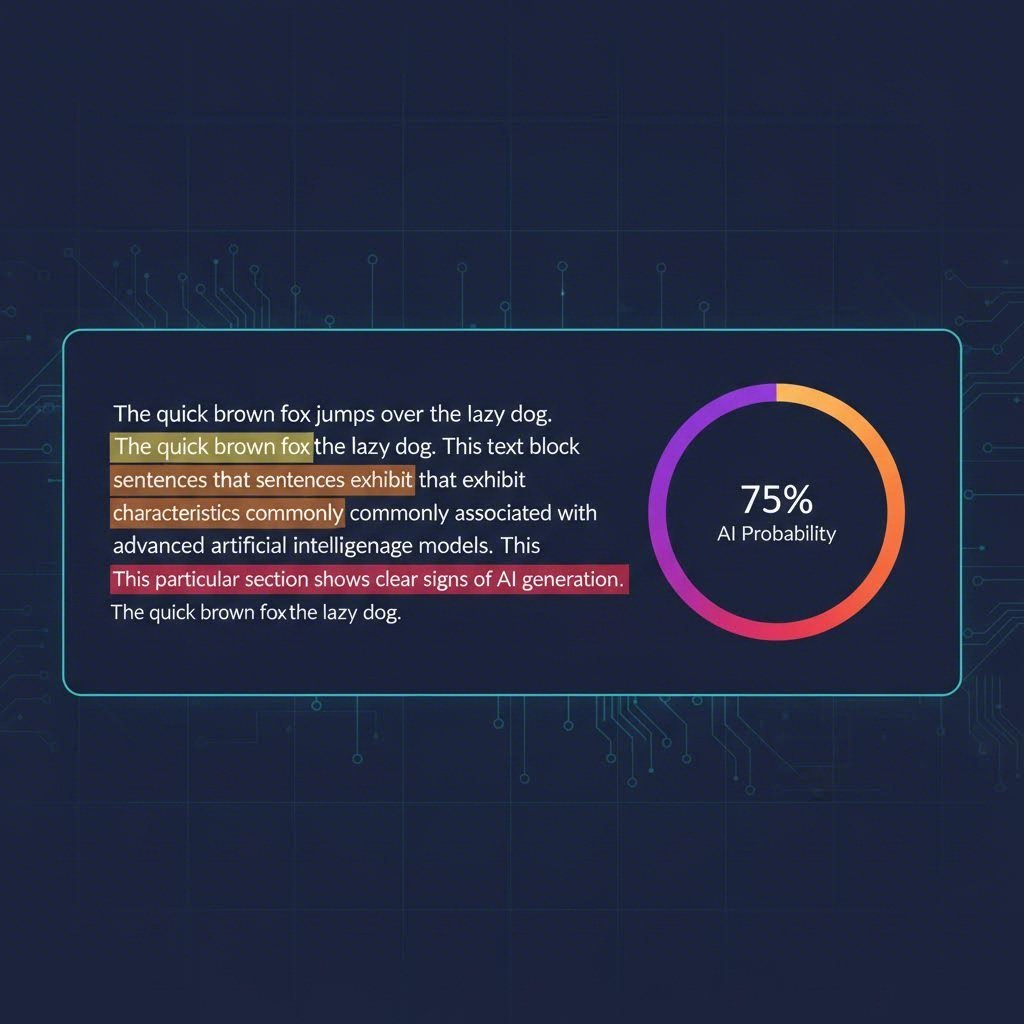
- Analyze the Results: Review the overall probability score and look for any highlighted sentences or paragraphs that the tool flags as suspicious.
- Cross-Reference with a Second Tool: To reduce the risk of a false positive from a single tool's algorithm, run the text through a second detector to see if the results are consistent.
| Tool | Key Feature | Free Tier Limit | Supported Models |
|---|---|---|---|
| GPTZero | Sentence-by-sentence highlighting and 'burstiness' score | 10,000 characters per scan | ChatGPT, GPT-5, Gemini, Claude |
| Scribbr AI Detector | Paraphrasing detection and multilingual support | 1,200 words per scan | ChatGPT, Copilot, Gemini |
| QuillBot AI Detector | Distinguishes between AI-generated and AI-refined text | Requires account for full features | ChatGPT, GPT-5, Gemini, Claude |
| Copyleaks | Claims over 99% accuracy and plagiarism checking | Limited daily scans | ChatGPT, GPT-5, Gemini & more |
Manual Detection: Training Your Human Eye to Spot AI
Beyond automated tools, developing a keen eye for the subtle giveaways of AI-generated text is an invaluable skill. Manual detection relies on critical thinking and an understanding of how machines write versus how humans write. While more time-consuming, this method is often more nuanced and can help confirm or deny the suspicions raised by a detector tool. AI-generated text often has a veneer of perfection that can feel unnatural upon closer inspection.
One of the most significant indicators is the writing style. AI models excel at producing grammatically perfect, clean prose, but they often lack a distinct voice or personality. The tone might be overly formal, generic, or shift abruptly without reason. The content may also lack depth; AI can summarize information effectively but often struggles to provide original analysis, personal anecdotes, or nuanced arguments. It assembles information based on patterns rather than true understanding, leading to text that is factually correct on the surface but hollow underneath.
To systematically check for AI-generated content, you can use a checklist of common red flags. These are patterns and characteristics that, while not definitive on their own, become highly suspicious when several appear in the same piece of writing.
- Flawless Yet Soulless: The text has perfect grammar and spelling but lacks any personal style, humor, or emotion. The sentence structure might be repetitive and formulaic.
- Factual Inconsistencies or Hallucinations: AI can invent facts, statistics, or even citations that look plausible but are entirely fake. A key step is always to verify any specific claims or sources mentioned.
- Vague and Generic Language: The writing often relies on buzzwords, jargon, and clichés without providing concrete examples or specific details. It explains what something is but rarely delves into the why or how with any originality.
- Unusual Phrasing: Sometimes, AI produces sentences that are grammatically correct but sound awkward or overly complex. This can happen when the model combines different patterns it has learned in an unnatural way.
- Lack of Contextual Nuance: AI often misses subtle social, cultural, or historical context. The writing might feel disconnected from real-world understanding and common sense.
The Limitations and Ethics of AI Content Detection
While AI detectors and manual checks are useful, it is critical to approach the task with a strong sense of caution and ethical responsibility. No detection method is 100% accurate. In fact, research and real-world examples have shown that detectors can be unreliable. Famously, these tools have incorrectly flagged human-written documents, like the U.S. Constitution, as being AI-generated. This highlights a significant risk: the potential for false accusations.
The consequences of a false positive can be severe, particularly in academic and professional settings. A student wrongly accused of academic dishonesty or a writer's work being unfairly rejected can have damaging repercussions. According to a resource from East Central College, these tools are particularly biased against non-native English speakers, whose writing patterns can sometimes mimic the simpler or more formal structures that detectors associate with AI, leading to a higher rate of false positives.
This creates a cat-and-mouse game where AI writing tools are constantly evolving to become more human-like, while AI detectors race to keep up. This dynamic means that detection is a moving target. As AI writing tools and detectors co-evolve, the focus shifts towards creating genuinely high-quality, original content. For instance, advanced platforms like BlogSpark aim to help creators produce engaging, SEO-optimized articles by transforming ideas into well-structured drafts with a customizable brand voice, moving beyond the generic patterns that detectors often flag.
Ultimately, AI detection results should never be used as a sole basis for punishment or judgment. They are best used as a tool to start a conversation, not end one. The most responsible approach combines automated and manual methods to form a preliminary assessment, which should then be followed by a direct and open discussion with the writer to understand their process and clarify any doubts.
Frequently Asked Questions
1. How do you detect if a text is written by AI?
Detecting AI-written text involves a two-part strategy. First, use a reliable AI detector tool to scan the text for statistical patterns common in machine-generated content. Second, perform a manual review, looking for signs like a lack of personal voice, perfect but generic grammar, factual errors or made-up sources, and repetitive sentence structures. Combining both methods provides a more accurate assessment than relying on one alone.
2. Is there a free AI detector?
Yes, many of the most popular and effective AI detectors offer free versions. Tools like GPTZero, Scribbr, and Copyleaks allow you to scan a limited amount of text (typically a few hundred to several thousand words) without a subscription. These free tiers are excellent for quickly checking individual articles or assignments, though paid plans are available for higher volume needs and more advanced features.