TL;DR
Finding the best AI for book writing depends entirely on your needs. For fiction authors seeking an easy-to-use tool with high-quality prose, Sudowrite is a top choice. Writers who demand absolute control and flexibility for world-building will prefer Novelcrafter. For versatile brainstorming, research, and drafting for both fiction and non-fiction, a powerful AI chatbot like Claude is an excellent and cost-effective option.
How to Choose the Best AI Book Writing Tool: Key Criteria
Selecting the right AI partner for your book is a critical decision. The market is flooded with options, from specialized novel-writing software to general-purpose chatbots. To make an informed choice, you need a clear evaluation framework. Understanding the key differences will empower you to find a tool that complements your unique writing process rather than hinders it.
First, it's important to distinguish between AI models and the software tools that use them. An AI model, like OpenAI's GPT-4 or Anthropic's Claude, is the engine that generates text. A specialized tool, like Sudowrite or Novelcrafter, is like a custom-built vehicle that harnesses that engine for a specific purpose—in this case, writing a book. As one expert from Kindlepreneur puts it, the model is the electricity, and the tool is the appliance. This distinction matters because some tools use their own fine-tuned models (like Sudowrite's Muse), while others let you connect to various models (like Novelcrafter), giving you more control.
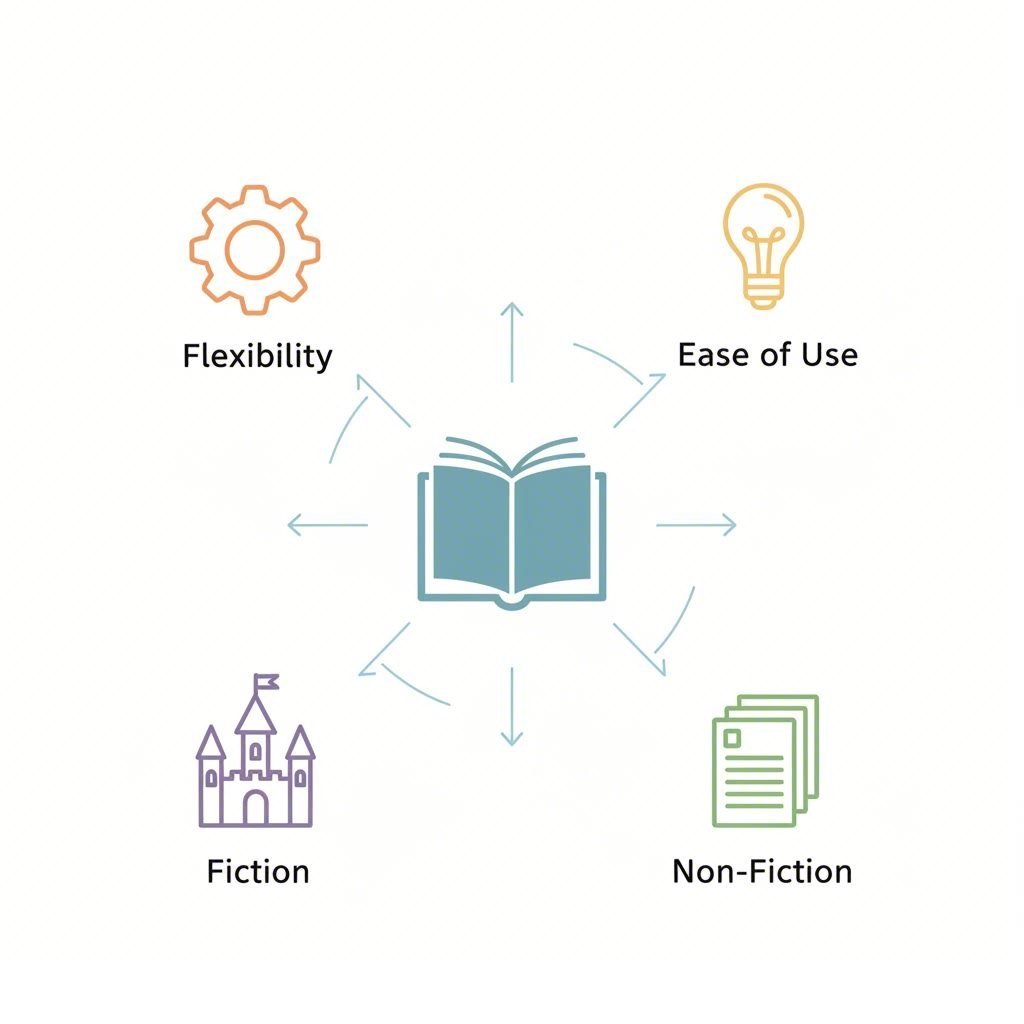
Your genre also heavily influences the best choice. Fiction writing requires creativity, character consistency, and narrative flow. Tools like Sudowrite are built from the ground up for this, with features like a 'Story Bible' to track lore and characters. Non-fiction, on the other hand, often demands research, clear structure, and factual accuracy. For this, a tool that can organize research within its framework, like Novelcrafter, or a research-focused AI like Perplexity, can be more effective. If you're a content creator who also writes books, a specialized service like BlogSpark's advanced AI blog writer can be invaluable for producing SEO-optimized articles, which is a common form of non-fiction for authors building a platform.
Finally, consider the trade-off between ease of use and flexibility. A tool like Sudowrite offers a simple, elegant design that's easy to jump into but offers less customization. In contrast, a platform like Novelcrafter is the "Adobe Photoshop of AI writing tools," providing ultimate flexibility to create custom prompts and even connect to local AI models on your own computer. This power comes with a steeper learning curve. Your choice depends on whether you want a straightforward writing assistant or a powerful, customizable co-authoring system.
Before you commit, ask yourself these key questions:
- What is my primary genre? (Fiction, creative non-fiction, technical manual)
- How much control do I want over the AI? (Simple prompts vs. custom models and recipes)
- What is my technical comfort level? (Plug-and-play vs. connecting APIs)
- What is my budget? (Free tools, monthly subscriptions, or pay-as-you-go models)
Top AI Writing Tools for Fiction Authors: In-Depth Reviews
For fiction authors, the ideal AI tool is more than a text generator; it's a creative partner that can help with brainstorming, world-building, and overcoming writer's block. The top contenders in this space are designed specifically for the art of storytelling, offering features that general-purpose AIs lack. Here, we compare the leading platforms to help you find the perfect fit for your narrative style.
| Tool | Key Features | Best For | Pricing (Starts At) | Underlying AI Model |
|---|---|---|---|---|
| Sudowrite | Story Bible, Chapter Generator, Describe, Rewrite, Muse LLM | Authors who want an easy-to-use solution with high-quality, creative prose. | $10/month | Proprietary Muse model, plus GPT and Claude variants |
| Novelcrafter | Codex for world-building, custom prompts, BYO AI model, scene beat expansion | Writers who want maximum control, flexibility, and deep world organization. | $8/month (with your own API key) or $14/month (with credits) | Model-agnostic (connects to OpenAI, Anthropic, Google, local models) |
| Squibler | Full-length book generation, project management, templates, collaboration tools | Writers looking for an all-in-one platform for drafting, organizing, and AI assistance. | $20/month (billed annually) | Likely uses OpenAI's GPT models via API |
Sudowrite: The AI Partner for Creative Prose
Sudowrite is widely regarded as one of the best AI writing partners specifically for fiction. Its standout feature is its proprietary 'Muse' model, which excels at producing natural, evocative prose that understands scene structure and pacing. The platform is designed to feel like a creative collaborator, offering tools like 'Describe' to paint vivid pictures and 'Expand' to flesh out rushed scenes. Its 'Story Bible' feature helps you maintain consistency with characters, settings, and lore throughout your manuscript.
The user interface is simple and elegant, making it accessible even for authors who are new to AI. Features like 'Brainstorm' help generate plot twists and character ideas, while 'Rewrite' offers infinite ways to rephrase a sentence without ego. This focus on creative assistance makes it a powerful tool for overcoming writer's block and enhancing your own writing.
Pros & Cons
- Pros: Exceptionally high-quality prose from its custom Muse model. Comprehensive and intuitive feature set designed for storytellers. Uncensored, making it suitable for all genres.
- Cons: Less flexible than competitors; you are limited to the models Sudowrite provides. The credit-based pricing structure can be a bit more expensive for heavy users.
Best For: Fiction authors who prioritize ease of use and the highest quality prose generation without needing deep technical customization. Learn more at Sudowrite's official website.
Novelcrafter: For Ultimate Control and World-Building
Novelcrafter is built for the author who loves planning and wants complete control over their writing process and AI tools. Its core is the 'Codex,' a powerful wiki where you can store detailed information about your characters, lore, and world. The AI can then access this information to maintain consistency while writing. This makes it an unparalleled tool for authors of epic fantasy, sci-fi, or any series that requires intricate world-building.
Its biggest differentiator is its flexibility. Novelcrafter is model-agnostic, meaning you can connect it to a wide range of AI models from providers like OpenAI, Anthropic (Claude), and Google, or even run local models from your own computer for enhanced privacy. You can also create custom 'prompt recipes' to tailor the AI's output to your specific needs. This level of customization is powerful but comes with a learning curve.
Pros & Cons
- Pros: Unmatched flexibility with AI model integration. The Codex is a superior tool for organizing complex stories. Extremely affordable, especially for users who bring their own API keys.
- Cons: Can be overwhelming for beginners due to its vast number of features. Requires some technical setup to connect external AI models.
Best For: Planners, world-builders, and tech-savvy authors who want a powerful, customizable system to manage and write complex narratives. Explore its features at Novelcrafter's homepage.
Squibler: The All-in-One Writing and AI Solution
Squibler aims to be a complete writing environment, combining project management features similar to Scrivener with a capable AI assistant. It offers templates for various genres, a drag-and-drop outliner, and collaboration tools. Its standout AI feature is the ability to generate a full-length first draft from a simple prompt, which can be a great way to kickstart a project or explore an idea.
The platform supports both fiction and non-fiction and includes unique features like an AI-powered image generator to help visualize scenes or characters. With its 'Smart Writer,' you can get help generating content, rewriting sections, or adding more conflict to your story. It's a solid choice for writers who want all their tools—outlining, drafting, and AI assistance—in one place.
Pros & Cons
- Pros: A unified platform for writing, organizing, and AI generation. Unlimited AI word generation on its Pro plan. Collaboration features are useful for co-authors.
- Cons: The web app can sometimes be slow. The quality of a fully AI-generated manuscript can be generic and requires heavy editing.
Best For: Authors who want a single, user-friendly application to manage their entire writing project, from initial outline to final draft, with unlimited AI assistance. See more at the official Squibler site.
Beyond Specialized Tools: Using AI Chatbots for Book Writing
While specialized tools offer tailored features, general-purpose AI chatbots like Claude, ChatGPT, and Gemini have become incredibly powerful and versatile writing assistants. For many authors, a subscription to one of these chatbots can serve as a flexible, cost-effective solution for a wide range of writing tasks. They excel at brainstorming, research, outlining, and overcoming the dreaded blank page.
Claude, from Anthropic, is often praised for the high quality of its prose. Its output tends to feel more natural and human-like than many competitors, making it a favorite for drafting fiction. Its large context window (the amount of information it can remember in a single conversation) is a massive advantage, allowing you to upload and discuss large portions of your manuscript for feedback or revision. You could, for instance, ask it to analyze a 100,000-word novel for pacing issues.
ChatGPT Plus, powered by OpenAI's models, is arguably the most powerful and feature-rich chatbot. It offers advanced functionalities like creating custom GPTs tailored to your writing style, voice integration for dictation or brainstorming aloud, and DALL-E for image generation. While its prose can sometimes feel a bit 'flowery,' its reasoning capabilities make it an excellent partner for plotting complex narratives or developing intricate character arcs.
For research-heavy projects, Perplexity is an invaluable tool. It functions like a search engine powered by AI, providing summarized answers to complex questions with cited sources. Whether you're writing historical fiction and need to verify details about a specific time period or a non-fiction book that requires accurate data, Perplexity can save you hours of research time.
Here are some of the best use cases for AI chatbots in your writing process:
- Brainstorming: Generate plot ideas, character names, or titles. For example: "Brainstorm five potential plot twists for a mystery novel set in a remote arctic research station."
- Outlining: Create a detailed chapter-by-chapter outline from a simple story concept.
- Research: Quickly gather information on any topic without leaving your writing environment.
- Overcoming Writer's Block: Describe where you're stuck, and the AI can offer suggestions on where the story could go next.
- Drafting and Expansion: Use the AI to write a rough first draft of a scene based on a few bullet points.
Important Considerations: Copyright, Ethics, and AI Detection
As AI becomes a more integrated part of the writing process, it raises important questions about ownership, originality, and ethics. Understanding these issues is crucial for any author using these powerful tools. The legal and creative landscape is still evolving, but some clear guidelines and best practices have already emerged.
One of the most pressing questions is about copyright. Can you legally write and own a book created with AI? The answer, according to legal consensus, is nuanced. AI is considered a tool, not a co-author. If you use AI to generate ideas or a rough draft but then significantly revise, edit, and add your own creative expression to the work, the copyright belongs to you. However, if you simply publish raw, unedited AI output, that content may not be eligible for copyright protection. The key is substantial human authorship; your input, creativity, and final polish are what make the work legally yours.
Beyond the legalities, there are ethical considerations. Relying too heavily on AI can risk producing generic content that lacks a unique authorial voice. The goal should be to use AI to augment your creativity, not replace it. Think of it as a collaborator that can handle the heavy lifting of a first draft or break through a creative block, freeing you up to focus on the higher-level aspects of storytelling—character depth, emotional resonance, and a unique narrative style.
To use AI both effectively and ethically, consider these best practices:
- Use AI as a starting point, not a finisher. Let it generate first drafts, outlines, or ideas, but always apply your own voice and significant edits.
- Always fact-check AI output. AI models can 'hallucinate' or invent facts, especially in non-fiction. Verify all data and historical details from reliable sources.
- Develop your unique authorial voice. The most successful authors have a distinct style. Use AI to explore possibilities, but ensure the final product sounds like you.
- Be transparent if required. While not always necessary, some platforms or publishers may have policies regarding the disclosure of AI use. Stay informed about the standards in your genre or market.
- Focus on quality. Readers can often spot low-effort, AI-generated content. Your reputation as an author depends on producing high-quality, engaging books that provide real value.

Frequently Asked Questions
1. What's the best AI to use to write a book?
The best AI depends on your needs. For fiction writers wanting high-quality, creative prose with an easy-to-use interface, Sudowrite is often recommended. For writers who need deep world-building and maximum control over the AI, Novelcrafter is a top choice. For general-purpose research, brainstorming, and drafting for any genre, a powerful chatbot like Claude or ChatGPT is an excellent, flexible option.
2. Can you use AI for writing a book?
Yes, absolutely. AI is a powerful tool that can assist authors in numerous ways throughout the book writing process. It can be used for brainstorming ideas, creating outlines, drafting initial chapters, developing characters, suggesting edits, and overcoming writer's block. The key is to use it as an assistant to augment your own creativity, not as a complete replacement for the human author.
3. Can I legally write a book using AI?
Yes, you can legally write a book using AI, but the legal protections for your work depend on your level of involvement. AI is considered a tool, much like a word processor or grammar checker. For your book to be protected by copyright, it must contain substantial human authorship. This means you must significantly edit, revise, and contribute your own creative expression to the AI-generated text. Simply publishing raw, unedited AI output may not grant you copyright ownership.