
TL;DR
Finding the best AI for writing books depends entirely on your genre and workflow. For fiction authors seeking high-quality, creative prose, Sudowrite is consistently praised as a top-tier writing partner. If you prioritize meticulous planning, world-building, and granular control over your story for either fiction or non-fiction, Novelcrafter is the superior choice. General chatbots like ChatGPT and Claude are also effective, particularly for outlining and drafting research-heavy non-fiction projects.
Understanding the AI Writing Landscape: Tool vs. Model
Before diving into specific recommendations, it's crucial to understand a key distinction: you don't just write with an AI, you write with a tool that uses an AI model. A large language model (LLM) like GPT-4 is the engine, capable of generating human-like text. A specialized AI writing tool, like Sudowrite or Novelcrafter, is the custom-built vehicle that harnesses that engine and equips it with features specifically for authors.
Think of it as the difference between a raw engine and a fully equipped car. While an LLM can produce text, a specialized tool provides the interface, organizational features, and targeted prompts to make the process efficient for book-length projects. This is a far cry from AI replacing human creativity. Instead, these tools act as collaborative partners, helping you brainstorm ideas, smash through writer's block, and streamline the drafting process. Many authors find them invaluable for maintaining momentum and exploring new creative avenues.
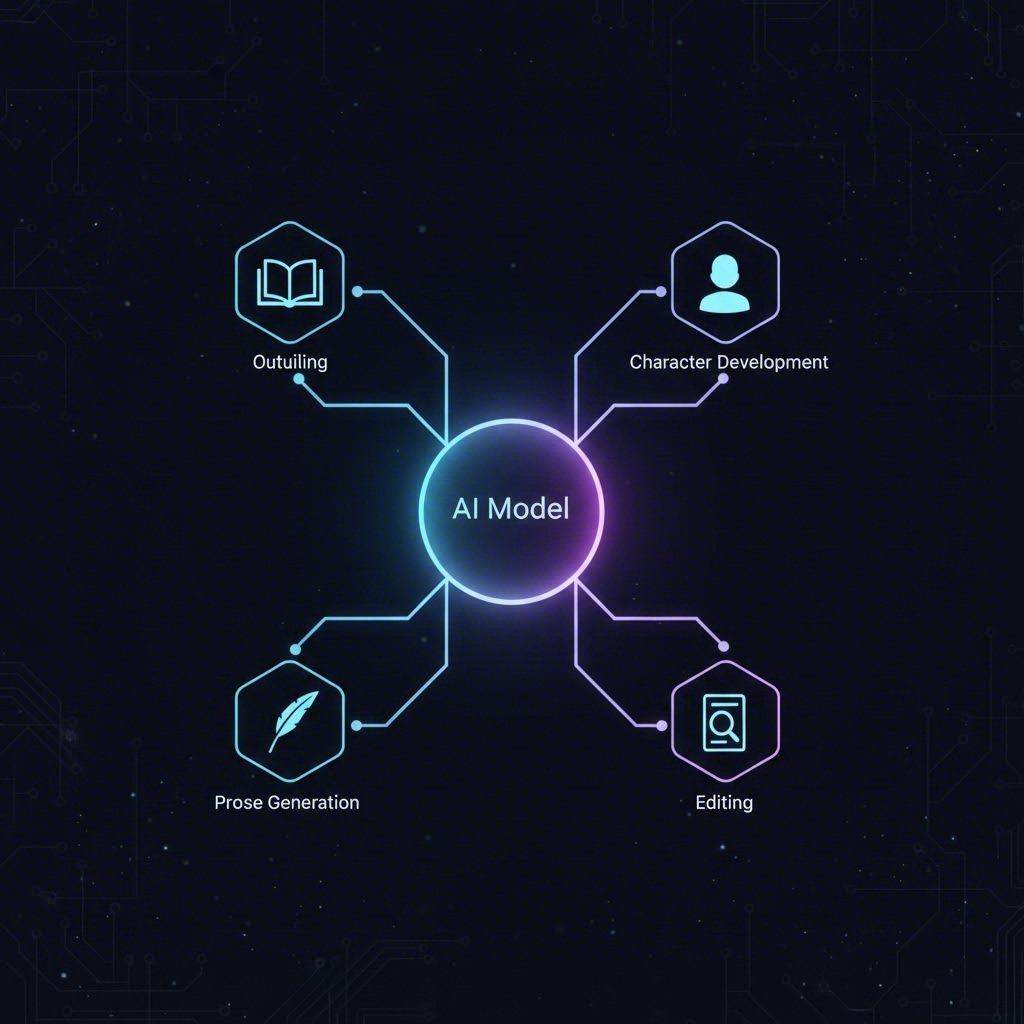
AI assistants can be integrated into nearly every stage of the book writing process. They excel at helping you:
- Brainstorming: Generating plot twists, character concepts, or unique settings.
- Outlining: Structuring your narrative arc, from a simple three-act structure to complex multi-chapter outlines.
- Character Development: Fleshing out backstories, motivations, and dialogue styles.
- Prose Generation: Expanding a simple sentence into a descriptive paragraph or drafting entire scenes based on your notes.
- Editing and Revision: Rewriting passages in a different tone, improving word choice, or polishing awkward phrasing.
The primary advantage is a massive boost in speed and idea generation. However, there are potential drawbacks. The output can sometimes feel generic without careful guidance, and every tool has a learning curve. The key is to view AI not as an author, but as an incredibly powerful assistant that requires your direction, taste, and creative vision to produce a compelling final manuscript.
Deep Dive: Top AI Tools for Fiction Authors
For novelists and creative writers, the goal is not just to write, but to write with style and voice. The best AI tools for fiction are designed to enhance prose, deepen narrative elements, and act as a creative muse. Based on extensive reviews and user feedback, two platforms consistently rise to the top: Sudowrite and Novelcrafter.
Sudowrite is widely regarded as the market leader for authors focused on the quality of their prose. It acts as a line-by-line partner, designed to help you write more descriptively and evocatively. Its core features, like 'Describe,' can take a simple observation and enrich it with sensory details, while its 'Story Bible' helps maintain consistency with characters and world details. Sudowrite's custom-trained models are tailored for fiction, often producing more nuanced and less robotic text than general-purpose AIs. It’s best for writers who want an easy-to-use solution to elevate their creative writing without getting bogged down in complex organizational systems.
Novelcrafter, on the other hand, is built for the meticulous planner. It offers unparalleled control and flexibility, making it ideal for authors of complex series or genres like fantasy and sci-fi that require extensive world-building. Its central feature, the 'Codex,' acts as a dynamic repository for all your story information—characters, locations, lore—which the AI can reference to ensure continuity. This makes it incredibly powerful for long-form projects where keeping track of details is paramount. As one in-depth review notes, it's for those who want absolute control over every tiny element of their story.
To help you decide, here is a breakdown of the leading options for fiction writers:
| Tool | Best For | Key Features | Pricing Model |
|---|---|---|---|
| Sudowrite | Creative prose and brainstorming | Describe, Story Bible, Rewrite, Brainstorm, Custom AI Models | Subscription-based Tiers |
| Novelcrafter | Structured writing and world-building | Codex (Story Bible), Outlining, Manuscript View, AI Referencing | Subscription + Pay-as-you-go AI Credits |
| Raptor Write | Beginners starting with AI | Guided workflow, simple interface, story structuring | Subscription-based Tiers |
Deep Dive: Top AI Tools for Non-Fiction Authors
The needs of a non-fiction author—whether writing a memoir, a history book, or a self-help guide—are different from those of a novelist. The emphasis is on clarity, structure, research, and factual accuracy. While many fiction tools can be adapted, some are inherently better suited for these tasks.
Novelcrafter shines here once again due to its powerful organizational capabilities. For a non-fiction project, the 'Codex' can be transformed into a research database. An author writing a biography could store timelines, key individuals, and sourced facts for the AI to reference when drafting chapters. This ensures that the generated text remains consistent with the established research, making it an excellent choice for authors of any research-heavy book.
Beyond specialized book-writing platforms, generalist chatbots are exceptionally useful for non-fiction. Tools like ChatGPT (specifically GPT-4) and Claude are powerful for summarizing complex articles, structuring arguments, and generating first drafts of chapters based on detailed outlines. You can feed them your research notes and ask them to synthesize the information into a coherent narrative, which you can then refine and edit with your own expertise and voice.
Many authors also manage platforms beyond their books, such as blogs for audience engagement. While the tools discussed are tailored for long-form manuscripts, other specialized AIs exist for different content formats. For instance, for authors who need to produce high-quality promotional content, a tool like BlogSpark's advanced AI blog writer is specifically designed to create SEO-optimized articles, helping to build an author's online presence efficiently.
Key use cases for AI in non-fiction writing include:
- Research Synthesis: Condensing academic papers, articles, and interviews into key takeaways.
- Structuring Content: Creating logical chapter outlines and section headings based on a core thesis.
- Drafting Explanations: Generating clear explanations of complex topics for a general audience.
- Fact Consistency: Using tools like Novelcrafter's Codex to ensure names, dates, and data are consistent throughout the manuscript.
Free vs. Paid: Choosing the Right AI Writing Assistant
A common question for authors is whether a free tool is sufficient or if a paid subscription is a necessary investment. The answer depends on the scope of your project and your commitment to using AI as a core part of your workflow. Free tools offer a fantastic entry point, while paid platforms provide the specialized power needed for a professional-grade book.
Free versions of chatbots like ChatGPT 3.5 or Claude can be surprisingly capable. They are excellent for brainstorming, outlining, and generating solid first-draft material. However, they have limitations. As noted in a comparison by The Writing Asylum, their prose can sometimes lack the nuance of more specialized models, and they often have smaller context windows, meaning they can 'forget' earlier parts of your story in a long writing session. This makes them less reliable for maintaining consistency across a full-length novel.
Paid, specialized tools like Sudowrite and Novelcrafter justify their cost by solving these specific problems. They offer higher-quality, custom-trained AI models, integrated organizational features like a Story Bible, and a user interface designed for long-form projects. The investment translates into greater efficiency, better output quality, and a more seamless workflow.
Here’s a clear comparison to guide your decision:
| Factor | Free Tools (e.g., ChatGPT 3.5) | Paid Tools (e.g., Sudowrite) |
|---|---|---|
| Pros | No cost to experiment, great for brainstorming, accessible to everyone. | Higher quality prose, specialized features, better context memory, workflow integration. |
| Cons | More generic output, limited context memory, lacks author-specific features. | Requires a subscription, may have a steeper learning curve. |
Our practical advice is this: start with free tools to understand the capabilities and limitations of AI. Use them for outlining and brainstorming to see how they fit your process. When you are ready to commit to writing a serious book project, investing in a paid subscription to a specialized tool is a worthwhile step for achieving professional-quality results and saving significant time.
Frequently Asked Questions
1. What is the best AI to write books?
There is no single 'best' AI for all authors. The ideal choice depends on your needs. For fiction writers who want to enhance their creative prose and get help with descriptive writing, Sudowrite is a top choice. For authors who prefer detailed planning and need strong organizational tools for world-building (in both fiction and non-fiction), Novelcrafter is the most powerful and flexible option.
2. Is it a good idea to write a book using AI?
Yes, using AI can be a very good idea when viewed as a collaborative tool. AI is excellent for accelerating the writing process, overcoming writer's block, brainstorming ideas, and polishing drafts. It does not replace the author's unique voice, creativity, or vision. Rather, it acts as an assistant that handles some of the heavy lifting, allowing you to focus on the core creative work of storytelling.
3. Is ChatGPT good for writing books?
ChatGPT can be a very useful tool for writing a book, especially for tasks like outlining, brainstorming character ideas, and drafting initial sections. However, it has limitations for a full-length novel. It lacks the specialized features of dedicated platforms like Sudowrite or Novelcrafter, such as a built-in story bible for consistency, and its output may require more significant editing to achieve a unique authorial voice.