

TL;DR
Finding the best AI for writing essays depends entirely on your specific needs. For comprehensive academic support, including research and citation, a tool like Paperguide stands out. If you need to refine your grammar and style, Grammarly is a strong choice. For paraphrasing and improving readability, QuillBot is highly effective. Ultimately, the right tool will act as a co-pilot, helping you brainstorm, structure, and polish your work, not replace your critical thinking.
Understanding the Modern AI Essay Writer
An AI essay writer is far more than a simple chatbot. It's a sophisticated assistant designed to streamline the academic writing process from start to finish. These tools leverage natural language processing to help you brainstorm topics, generate outlines, draft entire sections, and even find and format citations. While platforms like ChatGPT can be useful for initial ideas, dedicated essay writers offer more specialized features tailored for academic integrity and quality. Many operate on a freemium model, offering basic services for free with advanced features like plagiarism detection and in-depth analysis available through a paid subscription.
At their core, these AI tools are trained on vast databases of academic papers, books, and articles. This allows them to understand the nuances of academic language, structure, and tone. When you provide a prompt, the AI analyzes your input and generates text that is contextually relevant and stylistically appropriate. This technology can help you overcome writer's block by suggesting transitions, expanding on a point, or rephrasing a sentence for clarity. The key is to use them as a collaborator to enhance your own ideas, not as a shortcut to bypass the learning process.
To get started, you simply input your topic or a rough draft. The AI can then help you build a structured outline, suggest supporting arguments, or even write an introduction. Many platforms, like Yomu AI, offer an intelligent document assistant that provides feedback and completes your paragraphs. It's crucial to remember that while these tools are powerful, they are not infallible. You must always review and edit the generated content to ensure it aligns with your own voice and meets the assignment's requirements.
Free vs. Premium AI Writing Tools
Choosing between a free and a premium tool often comes down to the level of support you need. Free versions are excellent for basic tasks, but premium subscriptions unlock the most valuable features for serious academic work.
| Feature | Free Tools | Premium Tools |
|---|---|---|
| Core Functionality | Basic paraphrasing, grammar checks, limited text generation. | Advanced text generation, tone adjustment, in-depth analysis. |
| Plagiarism Detection | Often not included or very limited. | Integrated, high-quality plagiarism checkers are standard. |
| Citation Generation | Basic formats, may require manual checking. | Accurate, multi-style citation finders and formatters. |
| Word/Usage Limits | Strict daily or monthly limits on usage. | High or unlimited usage, allowing for work on long papers. |
| Advanced Features | None. | AI research assistants, PDF summarization, collaboration tools. |
A Detailed Review of the Top AI Essay Writing Tools
Navigating the growing market of AI essay writers can be challenging. To help you choose, we've reviewed some of the top contenders based on their features, ease of use, and ideal applications. While many tools are available, some, like BlogSpark, are designed for broader content creation. BlogSpark's advanced AI can transform ideas into SEO-optimized articles, offering intelligent outlining and brand voice customization, which can be invaluable for students and professionals looking to scale their writing beyond academic essays.
1. Paperguide
Paperguide presents itself as an all-in-one academic solution, and it largely delivers on that promise. It's more than just a writer; it’s a research assistant.
- Overview: Designed specifically for academic work, Paperguide integrates writing, research, and citation management into a single platform. It's ideal for students working on research-heavy papers and theses.
- Key Features: The platform boasts an advanced AI writer that can generate introductions, conclusions, and counterarguments. Its standout feature is the ability to search a database of over 200 million research papers and generate cited answers to your questions. It also includes a robust plagiarism checker.
- Pros & Cons: Its strengths are its comprehensive feature set and user-friendly interface. A potential downside is the limited storage (500 MB) on the free plan.
- Ideal Use Case: Best for undergraduate and graduate students who need a powerful tool to manage the entire research and writing lifecycle.
2. Grammarly
While not exclusively an essay writer, Grammarly's AI-powered suggestions make it an indispensable tool for polishing any academic paper.
- Overview: Grammarly is a widely-used writing assistant that checks for grammar, spelling, punctuation, and style. Its generative AI features can now help rewrite paragraphs, adjust tone, and brainstorm ideas.
- Key Features: Real-time suggestions, tone detection (formal, confident, etc.), and a plagiarism checker are its core strengths. The generative AI can expand on short paragraphs, though a test by Lifehacker found it can sometimes add fluff.
- Pros & Cons: It's incredibly easy to use and integrates with most platforms. However, its generative AI can be hesitant with sensitive topics, and its primary focus is on correction rather than initial content creation.
- Ideal Use Case: Perfect for the final editing and proofreading stage of any essay to ensure clarity, correctness, and professionalism.
3. QuillBot
QuillBot excels at helping you rephrase and refine your writing, making it a powerful tool for improving readability and avoiding unintentional plagiarism.
- Overview: Primarily known for its state-of-the-art paraphrasing tool, QuillBot also offers a grammar checker, summarizer, and citation generator. It's designed to enhance existing text rather than create it from scratch.
- Key Features: The Paraphraser allows you to adjust the level of vocabulary change and offers multiple modes (e.g., Standard, Fluency, Formal). The platform also includes a Co-Writer space to bring all its tools together.
- Pros & Cons: It is highly effective at improving sentence structure and is more affordable than many competitors. The main limitation is that its free version is quite restrictive, and it lacks a built-in plagiarism checker.
- Ideal Use Case: Excellent for students who have a draft but want to improve its flow, vary their sentence structure, or summarize research articles quickly.
4. JotBot
JotBot offers a unique feature that helps tailor AI-generated text to your personal writing style, making the output feel more authentic.
- Overview: This tool is designed to be a collaborative partner during the writing process. It can generate outlines, suggest subtopics, and even mimic your writing style.
- Key Features: The ability to upload your past essays to replicate your style is its most innovative feature. It provides suggestions as you type, helping to overcome writer's block.
- Pros & Cons: It's a cool and interactive tool for idea generation. However, even with the style mimicry, the output can still be flagged by AI detectors, and its credit-based system can be confusing.
- Ideal Use Case: A great choice for writers who struggle with initial brainstorming and want an AI assistant that provides continuous, personalized suggestions as they work.
Essential Features and Ethical Guidelines for Using AI
Choosing the right AI writer involves more than just looking at its ability to generate text. To ensure academic success and integrity, you must prioritize specific features and use these tools responsibly. The goal is to use AI as a powerful assistant, not a ghostwriter. This approach not only protects you from academic dishonesty but also helps you develop your own critical thinking and writing skills.
When evaluating tools, look for a core set of features that support high-quality academic work. A built-in, reliable plagiarism checker is non-negotiable. An accurate citation generator that supports multiple styles (like APA, MLA, Chicago) is also critical, as this addresses the common challenge of proper referencing. Furthermore, the ability to adjust the tone and style of the writing ensures the output matches the formal requirements of your assignment. Some advanced tools even offer research integration, helping you find and synthesize credible sources directly within the platform.
A Checklist for Ethical AI Use
Using AI in your academic work requires a clear understanding of the ethical boundaries. Misuse can lead to serious consequences, including failing grades or academic suspension. Follow this checklist to ensure you're using AI as a legitimate learning aid:
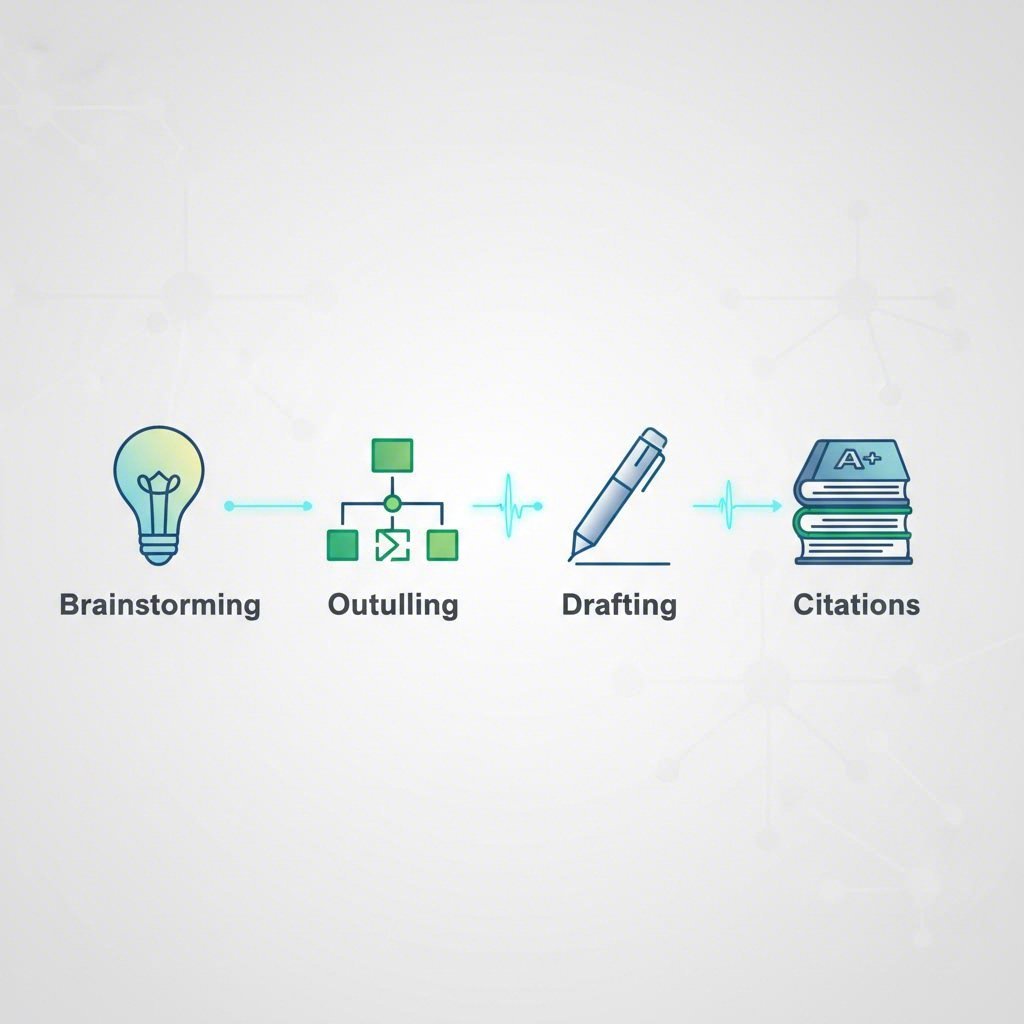
- Brainstorming and Outlining: Use AI to explore topic ideas, generate potential research questions, and create a structured outline. This is a great way to organize your thoughts before you start writing.
- Drafting with Your Own Ideas: If you use AI to generate text, treat it as a first draft. Immediately rewrite it using your own words, analysis, and insights. Never copy and paste directly into your final submission.
- Fact-Checking and Source Verification: AI tools can sometimes produce inaccurate information or even invent sources, a phenomenon known as "hallucination." You must independently verify every fact, statistic, and citation the AI provides.
- Focus on Refinement: Leverage AI for what it does best: improving what you've already written. Use tools like those from Scribbr or Grammarly to check for grammatical errors, improve sentence structure, and enhance clarity.
- Final Plagiarism Check: Always run your completed essay through a reliable plagiarism detector to ensure your work is original and properly cited.
Frequently Asked Questions
1. Can ChatGPT write essays without plagiarizing?
ChatGPT does not intentionally plagiarize, but it generates text based on patterns from its training data. This means its output can be very similar to existing sources without proper attribution. To avoid plagiarism, you must treat its output as a starting point, rewrite it in your own voice, add original analysis, and cite all sources properly.
2. Which AI is better than ChatGPT for essay writing?
While ChatGPT is a powerful generalist, specialized tools are often better for essay writing. Platforms like Paperguide, Yomu AI, and QuillBot offer features tailored for academic work, such as built-in citation generators, plagiarism checkers, and access to academic databases. These tools provide a more structured and reliable environment for writing essays.
3. Is ChatGPT the best AI writer?
ChatGPT is an excellent tool for brainstorming, outlining, and generating initial ideas. However, it is not always the best for producing a final, polished academic essay. Dedicated AI writing assistants often provide superior features for grammar, style, citation, and ensuring academic integrity, which are critical for student success.